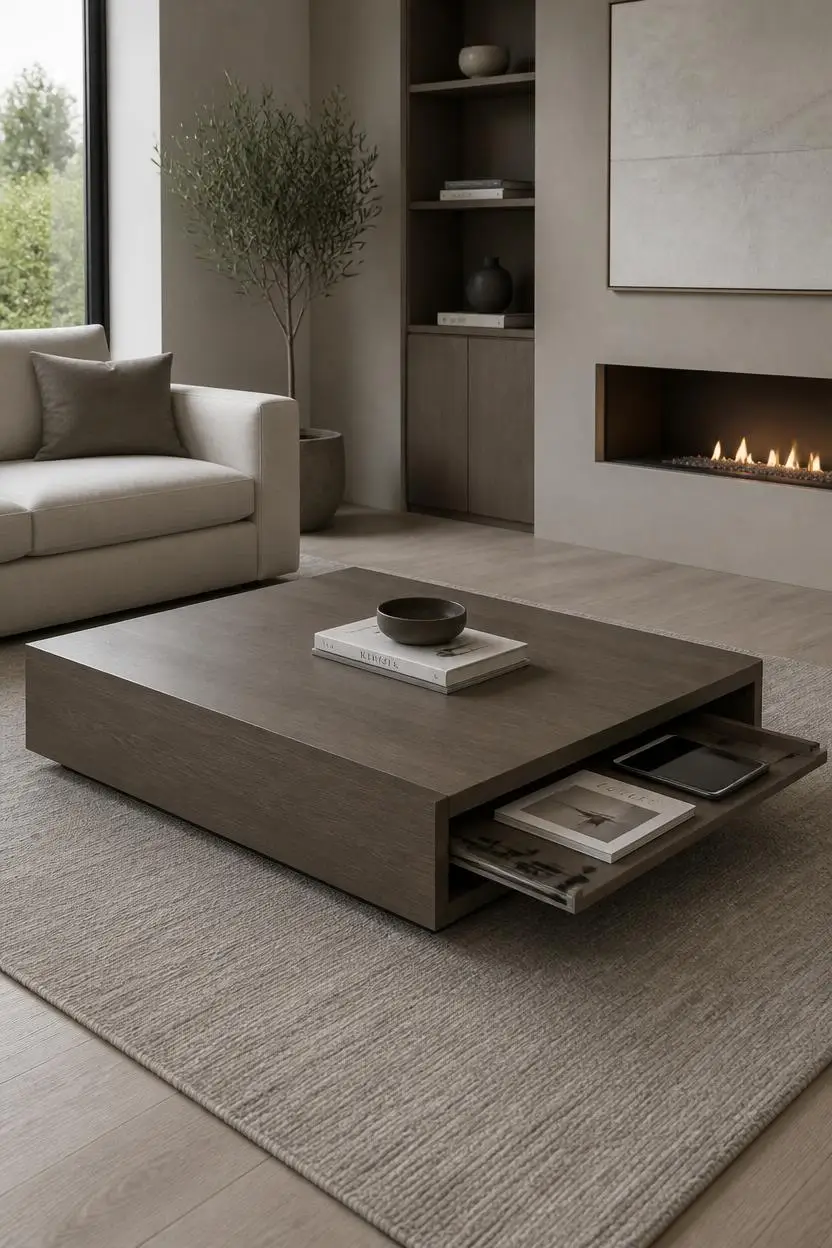
10 DIY Coffee Table with Storage Ideas That Will Transform Your Living Room
This article was created in line with Trends Oraa’s research and content standards.
Most people don’t realize this.
Their living room isn’t messy — it just doesn’t have enough smart storage.
The good news? Fixing it is easier than you think.
If you’ve ever shoved remotes, magazines, blankets, and random clutter under the couch just before guests arrive, you already know the problem. Your coffee table is prime real estate sitting right in the middle of your room, and most of us are wasting it. A DIY coffee table with storage isn’t just a furniture project — it’s a full living room reset.
You might also love our guide on the ultimate guide to styling a coffee table like a pro if you want your finished piece to actually look as good as it functions.
In this guide, I’m walking you through 10 DIY coffee table with storage ideas that go way beyond a basic box on legs. Some are budget-friendly weekend projects. Others are statement pieces for larger rooms. All of them solve the same annoying problem: not enough places to put your stuff without it looking like stuff.
Stick around, because idea #6 is one that most people completely overlook — and it might be the smartest one on this list.
Why a DIY Coffee Table with Storage Ideas Approach Actually Works
Before we jump into the list, let’s talk about why this matters.
A coffee table sits at the center of how your living room functions every single day.
- It’s where remotes disappear.
- It’s where mail piles up.
- It’s where kids’ toys migrate to.
- It’s where blankets get tossed at the end of movie night.
When your coffee table has built-in storage, all of that clutter has a home. And when clutter has a home, your entire room instantly feels calmer.
Here’s where it gets interesting — this isn’t just about tidiness. Research on home organization consistently links visual clutter to increased stress. A coffee table with hidden storage isn’t just a design choice. It’s a small daily win for your mental space.
Would you choose function or style? With the ideas below, you honestly don’t have to pick.
1. The Lift-Top Coffee Table With Hidden Compartment
What You’re Seeing
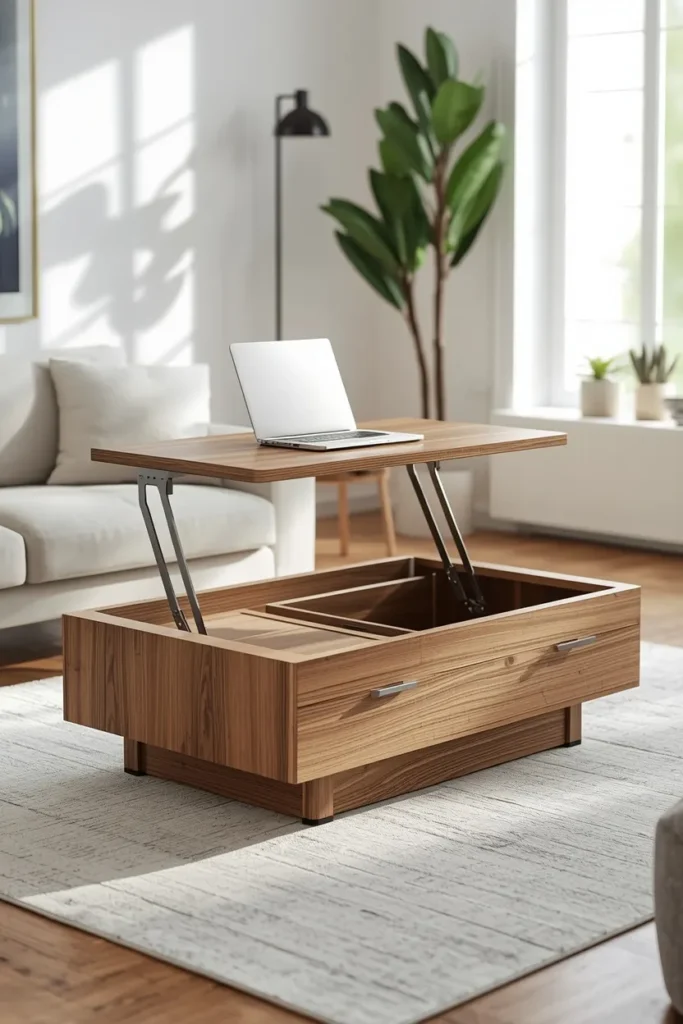
Picture a clean-lined wooden coffee table that looks completely ordinary — until the top panel lifts up and slides forward into a laptop-height workspace, revealing a shallow storage cavity underneath.
Design Breakdown
This build starts with a basic rectangular table frame, but the magic is in the hinged top. You attach the tabletop using a piano hinge or a sliding hardware kit, so it can lift and lock at an angle for working, eating, or gaming, while still closing flush for a clean look.
Expert Tip
Use soft-close hinges. They’re a few extra dollars, but they prevent the lid from slamming down on little fingers or fragile items stored inside.
Why It Works
It solves two problems at once — hidden storage and a functional surface for laptops, trays, or breakfast in bed on the couch.
Best For
- Small spaces
- Renters
- Budget makeovers
Common Mistake To Avoid
Skipping the support struts. Without them, the lifted top has nothing holding it at an angle, and it’ll either fall shut or feel flimsy.
Quick Wins
- Doubles as a laptop desk
- Hides remotes, chargers, and coasters instantly
- Works in apartments where a full desk isn’t practical
- Easy weekend build with basic tools
2. The Rustic Crate-Style Coffee Table With Open Shelving
What You’re Seeing
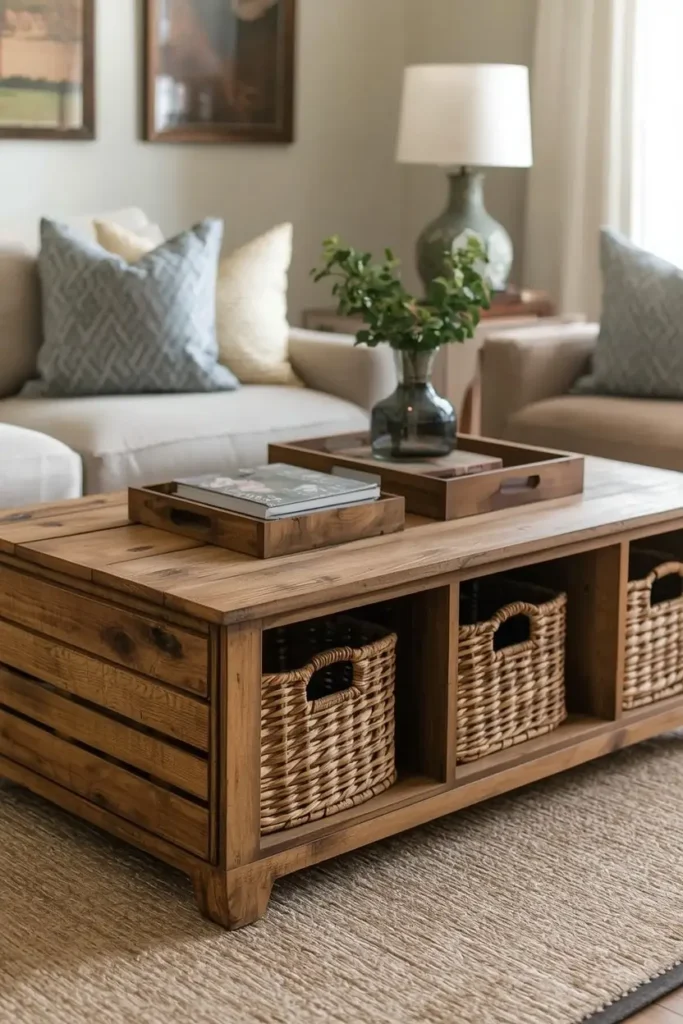
Imagine walking into a living room and seeing a low, wide coffee table built from stacked wooden crates, styled with woven baskets tucked into each open cubby.
Design Breakdown
This one is built from repurposed wooden crates or new pine boxes joined side by side, then topped with a single flat surface. The open-front design means everything stored inside is visible, so styling matters as much as function.
Expert Tip
Stain the crates a shade darker than your flooring so the table grounds the room instead of blending into it.
Why It Works
Open shelving forces a little discipline — you naturally want what’s visible to look intentional, which keeps clutter from creeping back in.
Best For
- Budget makeovers
- Families
- Large spaces
Common Mistake To Avoid
Overfilling the open cubbies with mismatched items. It reads as messy instead of curated.
Quick Wins
- Great for displaying books and baskets
- Inexpensive materials, especially with reclaimed wood
- Easy to customize the number of crates for your space
- No hardware or hinges required
Most people don’t know this: open-storage coffee tables actually photograph better for Pinterest and home tours than closed ones, because there’s visual texture to see. But here’s the important part — that same openness means you need a system. I always recommend picking two or three basket colors max and sticking to them. One thing I’ve learned after styling dozens of these tables is that consistency beats quantity every time. A table with three matching baskets looks curated. A table with five mismatched containers looks like storage overflow.
Most people waste more space than they realize.
3. The Drawer-Front Coffee Table for a Furniture-Store Look
What You’re Seeing
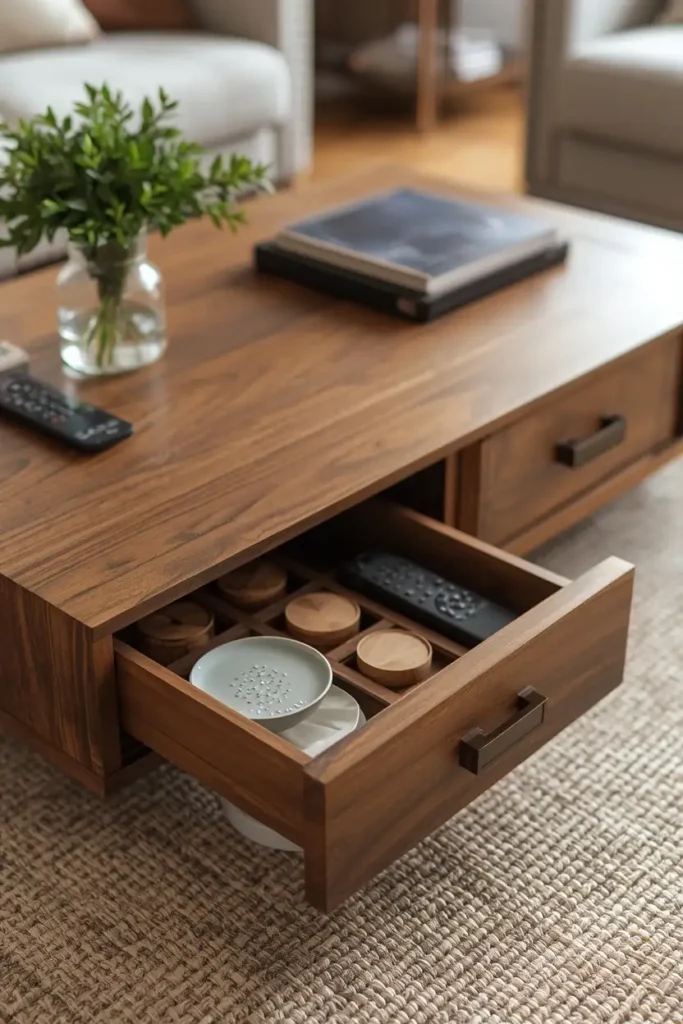
Think about how much easier movie nights become when your remotes, coasters, and charging cables slide into a smooth-gliding drawer instead of living loose on top of the table.
Design Breakdown
This build uses a simple box frame with one or two full-width drawers mounted on drawer slides. It mimics the look of a store-bought console table but costs a fraction of the price when built yourself.
Expert Tip
Buy your drawer slides before you build the frame, not after. Slide hardware varies in required clearance, and building around the actual slides saves you a frustrating redo.
Why It Works
Closed storage completely hides clutter, which makes the room feel more polished with almost no daily effort.
Best For
- Small spaces
- Luxury homes
- Renters
Common Mistake To Avoid
Choosing drawers that are too shallow. Test-fit your remotes and everyday items before finalizing the drawer height.
Quick Wins
- Fully hides clutter from view
- Looks like a high-end furniture piece
- Great for renters since it’s freestanding, not built-in
- Customizable with paint or stain to match any decor
You May Also Like:
- Space-Saving Furniture Ideas
- Wood Desk Ideas
- Small Console Tables Ideas
- DIY Furniture Makeover Ideas
- Family Room Ideas
4. The Ottoman-Style Storage Coffee Table
What You’re Seeing
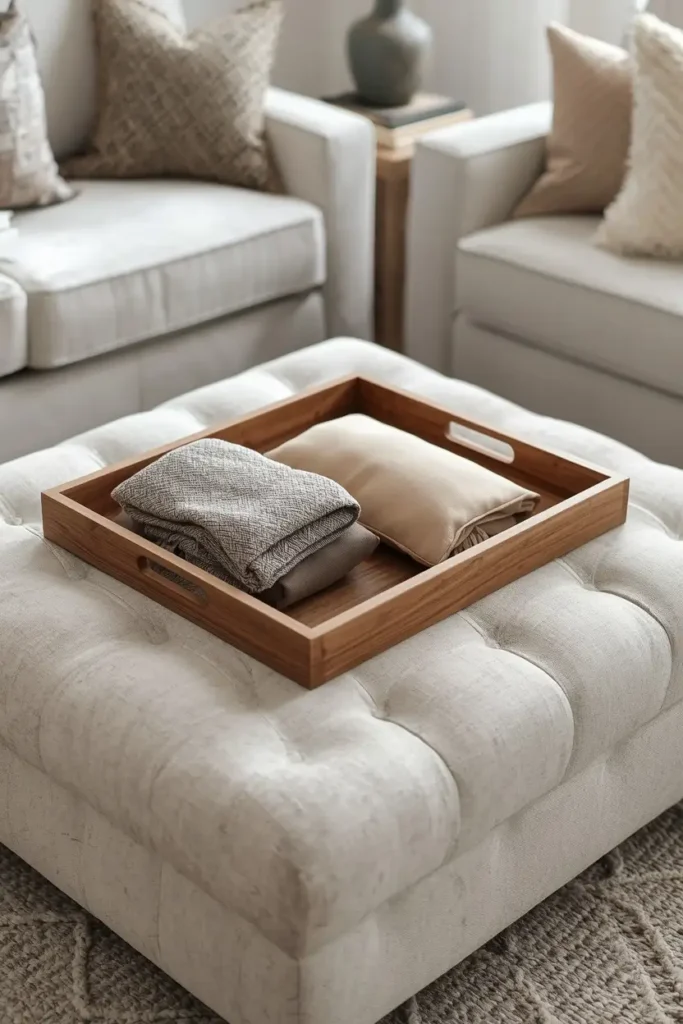
Picture yourself enjoying a soft, upholstered ottoman coffee table with a removable tray top, revealing a deep interior perfect for blankets and pillows.
Design Breakdown
Build a simple wood frame, add a hinged or lift-off lid, and upholster the exterior with fabric or faux leather. A tray placed on top gives you a hard surface for drinks when needed.
Expert Tip
Use a removable serving tray rather than a permanently attached lid. It’s more versatile and easier to clean.
Why It Works
Soft seating-style tables feel cozier and double as extra seating for guests, which matters most in smaller living rooms.
Best For
- Small spaces
- Families
- Budget makeovers
Common Mistake To Avoid
Choosing a fabric that isn’t stain-resistant, especially with kids or pets in the house.
Quick Wins
- Doubles as extra seating
- Softens a room full of hard furniture
- Ideal for hiding bulky blankets and throw pillows
- Kid-friendly with rounded edges
Which of these ideas would work best in your home?
5. The Two-Tier Coffee Table With a Concealed Lower Shelf
What You’re Seeing
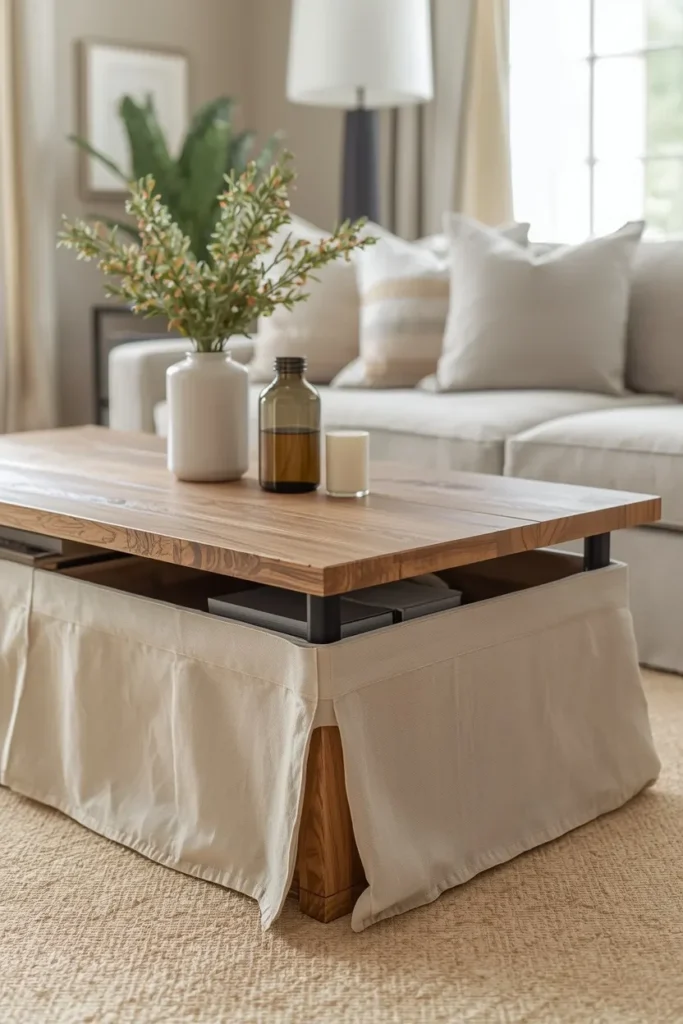
Visualize the difference between a cluttered lower shelf and a two-tier table where the bottom level is enclosed with a fabric skirt or slatted panel, hiding everything from view.
Design Breakdown
This design takes a standard two-tier coffee table and adds a simple concealment element — either a curtain-style fabric panel on a tension rod, or slatted wood panels — around the lower shelf.
Expert Tip
If you go with fabric, choose a heavier linen blend. Lightweight fabric sways and looks unfinished; heavier fabric hangs cleanly.
Why It Works
Two-tier tables already offer more storage than single-surface designs, and concealing the lower shelf gets rid of the “junk shelf” look most open designs eventually fall into.
Best For
- Large spaces
- Families
- Renters
Common Mistake To Avoid
Forgetting to measure the exact shelf height before ordering fabric or panel material — an ill-fitting skirt looks worse than an open shelf.
Quick Wins
- Hides bulky items like board games and baskets
- Easy fabric swap to refresh the whole look seasonally
- Works with tables you already own
- Budget-friendly upgrade under $50
Here’s where it gets interesting: a concealed lower shelf is one of the highest-impact, lowest-effort upgrades on this entire list. You’re not building a table from scratch — you’re transforming a table you may already own. I’ve seen this exact trick take a tired, cluttered coffee table and make it look brand new in under an hour. If you’re not ready to commit to a full DIY build yet, start here. It’s the easiest way to test whether hidden storage actually changes how you use your living room.
What’s your biggest challenge right now — too little storage, or storage that just doesn’t look good?
The next idea is one designers secretly love.
6. The Nesting Coffee Table Trio With Individual Storage Bins
What You’re Seeing
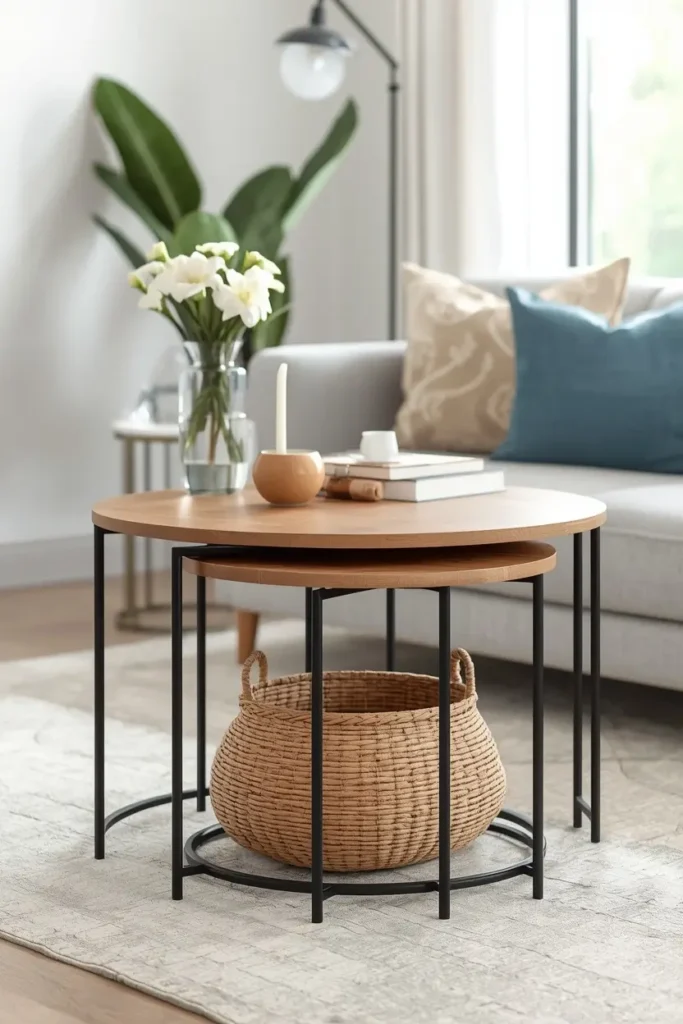
Imagine three coffee tables of graduated sizes, each one holding its own small storage basket underneath, tucked together so they read as one piece when nested.
Design Breakdown
Nesting tables are typically thought of as a styling trick, but adding a small open shelf or basket slot to each one turns the entire set into a distributed storage system. You can pull one table out for extra surface space while keeping the others tucked in.
Expert Tip
Assign each table a “job” — one for remotes, one for coasters and candles, one for reading material. It keeps the system from becoming a catch-all.
Why It Works
This is where it gets interesting: instead of one large storage zone, you get three smaller ones, which is often easier to keep organized because each has a defined purpose.
Best For
- Small spaces
- Renters
- Budget makeovers
Common Mistake To Avoid
Making all three tables identical in finish and basket style — it reads as one bulky piece instead of an intentional nesting set.
Quick Wins
- Flexible for entertaining — pull tables apart for guests
- Distributed storage is easier to maintain than one big bin
- Great for small apartments needing flexible furniture
- Inexpensive to build using pre-cut table legs
Don’t skip the next tip — the mid-article guide below breaks down exactly what this kind of project actually costs.
The Real Budget Breakdown for a DIY Coffee Table With Storage
This is the section most guides skip, and it’s the one that actually matters most before you start cutting wood.
Here’s the important part: your budget depends far more on your chosen storage style than the size of the table itself. Let’s break it down.
Basic Materials Cost Range
- Plywood or pine boards (frame + top): $40–$120
- Hairpin or basic wood legs: $25–$60 for a set of four
- Drawer slides (if building drawer-style): $15–$35 per drawer
- Piano hinge or lift-top hardware: $10–$25
- Stain, paint, or sealant: $15–$30
- Casters (optional, for mobility): $10–$25
Typical Total Cost by Style
- Crate-style open shelving: $60–$150
- Lift-top hidden storage: $100–$220
- Drawer-front build: $130–$280
- Upholstered ottoman-style: $90–$200
- Two-tier with concealment: $70–$160
The next idea changes everything, so keep this cost breakdown in mind as you read on — it’ll help you decide which build actually fits your budget before you commit to materials.
Where Beginners Overspend
- Buying pre-made hardware kits when basic slides work fine
- Choosing hardwood when a painted softwood would look identical
- Overbuying stain or sealant (a quart usually covers 2–3 coats on a standard table)
Where It’s Worth Spending More
- Soft-close hinges — cheap hinges fail faster and can pinch fingers
- Quality drawer slides — inexpensive ones stick and wear out within a year
- A proper wood sealant if the table will hold drinks regularly
Common Mistakes That Blow the Budget
- Not measuring your space before buying materials, leading to wasted cuts
- Choosing a design that’s too ambitious for your first build
- Skipping a sanding step, which then requires buying extra finish to compensate for a rough surface
A realistic first-time budget for most of these projects lands between $80 and $200, assuming you already own basic tools like a drill, saw, and sander. If you’re renting tools or buying them for the first time, add another $50–$150 depending on what you need.
The following idea surprised me the most, because it costs almost nothing compared to everything else on this list.
7. The Repurposed Vintage Trunk Coffee Table
What You’re Seeing
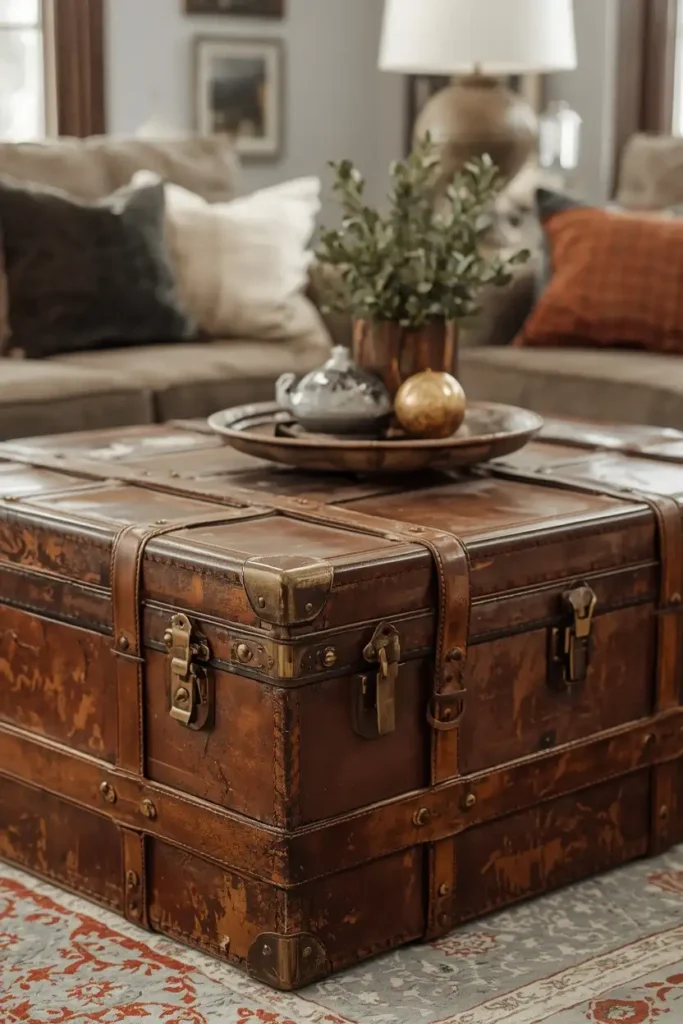
Picture a weathered vintage trunk sitting at the center of a living room, its worn leather straps and brass hardware doubling as both a coffee table and a deep storage chest.
Design Breakdown
This is less “build” and more “repurpose.” An old steamer trunk, thrifted chest, or even a sturdy vintage suitcase stack can become your coffee table with almost no construction required. Add furniture pads or small casters to the bottom for floor protection and mobility.
Expert Tip
Check flea markets and estate sales before furniture stores — vintage trunks in this style are often priced under $60 and have far more character than anything new.
Why It Works
This is where many homeowners make a mistake: they assume storage furniture has to be built. A trunk gives you significant, deep storage space with zero woodworking skill required, plus built-in vintage charm.
Best For
- Budget makeovers
- Large spaces
- Renters
Common Mistake To Avoid
Skipping a lid support. Trunk lids can be heavy and unexpectedly snap shut without a chain or strut holding them open.
Quick Wins
- No building required — just source and style
- Huge interior storage capacity
- Adds instant vintage character
- Great conversation piece for guests
You May Also Like:
- Country Farmhouse Decor Ideas
- Cozy Living Room Ideas
- Living Room Remodel Ideas
- DIY Organization Hacks
- Apartment Organization Ideas
Which design would you try first — a full build, or a repurposed piece like this one?
8. The Modular Cube Coffee Table System
What You’re Seeing
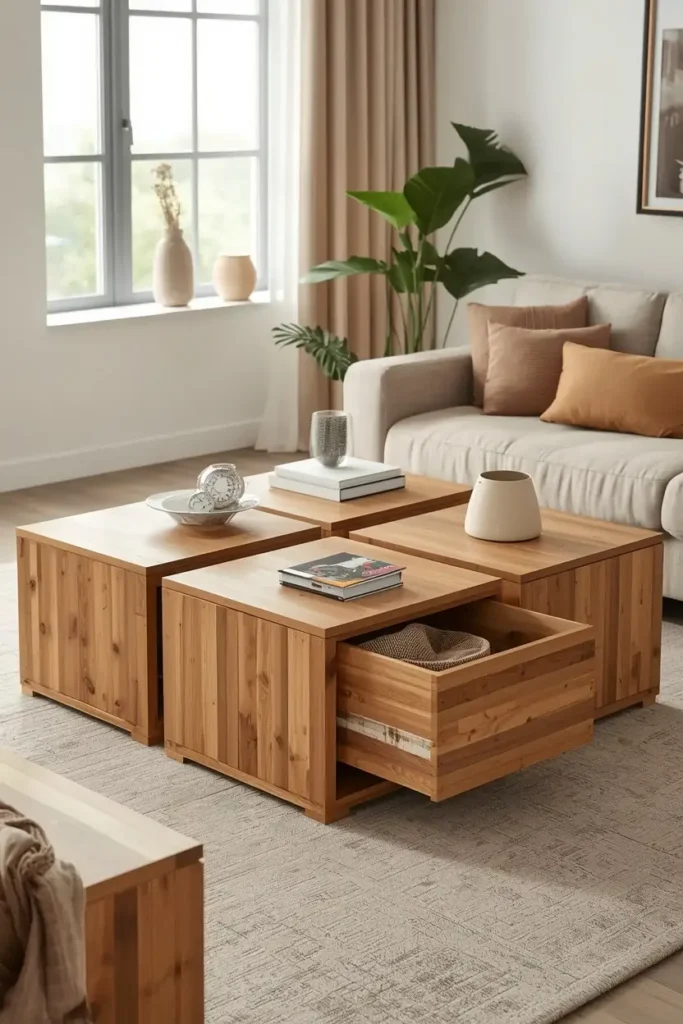
Think about how much easier hosting becomes when your coffee table is actually four separate storage cubes that can split apart into extra seating or side tables whenever you need them.
Design Breakdown
Build four (or more) identical wooden cubes with a hinged or lift-off top, each with a small storage compartment inside. Arrange them together as one coffee table, or pull them apart for game night, extra seating, or a kids’ playroom setup.
Expert Tip
Add felt pads to the bottoms of each cube so they can be rearranged without scratching your flooring.
Why It Works
Flexibility is the real win here. Most furniture is fixed in function, but this system adapts to whatever your room needs on a given day.
Best For
- Small spaces
- Families
- Large spaces
Common Mistake To Avoid
Making the cubes too heavy to move easily — stick to lightweight plywood rather than solid hardwood if flexibility is your priority.
Quick Wins
- Multi-functional: table, seating, or side tables
- Individual storage per cube keeps items organized by category
- Great for kids’ rooms doubling as a playroom
- Easy to build in batches with consistent measurements
One thing I’ve learned building furniture for small spaces: flexibility is underrated. A fixed coffee table works fine until you host a get-together and suddenly need more seating or surface space. Modular cube systems solve that instantly. But here’s the important part — don’t overbuild the storage compartments inside each cube. Keep them shallow and simple. The whole point is that these pieces need to stay light enough to actually move around, and a deep, heavy storage cavity defeats that purpose.
Let me know which one is your favorite so far.
This simple change can completely transform the room.
9. The Slide-Out Magazine and Media Rack Coffee Table
What You’re Seeing
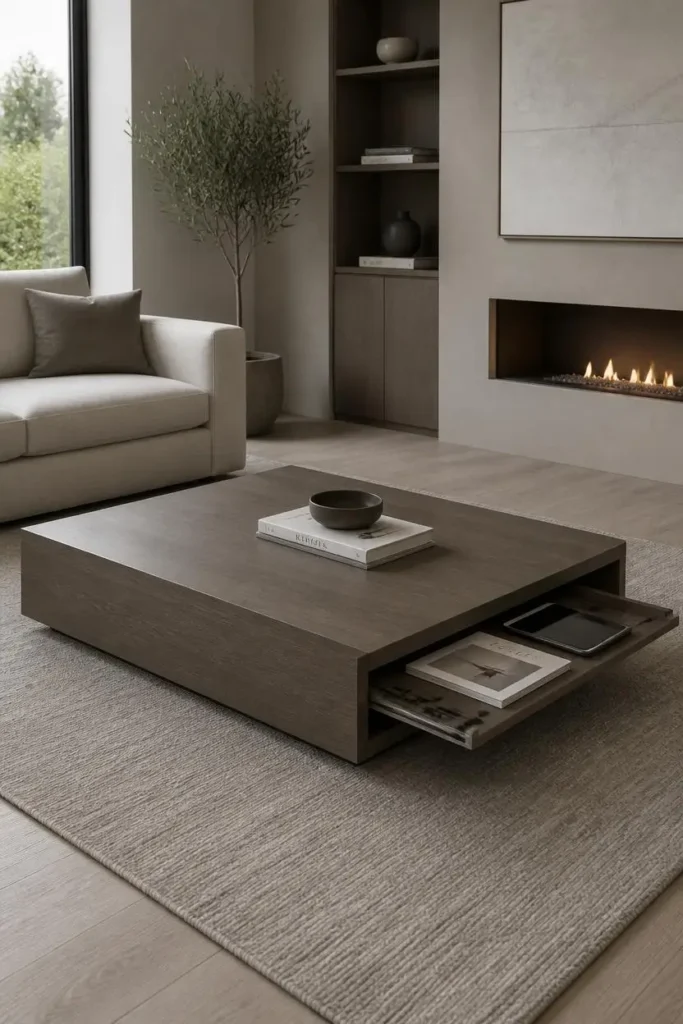
Visualize a sleek, low-profile coffee table with a thin slide-out rack tucked into the side, perfectly sized for magazines, tablets, or a stack of coasters and remotes.
Design Breakdown
This build adds a narrow vertical slot along one side of the table frame, with a thin pull-out rack on drawer slides. It’s a smaller storage solution than a full drawer, but it’s ideal for flat items that usually end up scattered on top of the table.
Expert Tip
Size the rack slightly narrower than a standard magazine so items don’t slide around loosely when the rack is pulled out.
Why It Works
Not everything needs deep storage — sometimes a thin, dedicated slot solves 80% of your daily clutter with a fraction of the build effort.
Best For
- Small spaces
- Budget makeovers
- Renters
Common Mistake To Avoid
Making the slot too tight, which causes magazines and folders to jam when sliding in or out.
Quick Wins
- Perfect for magazines, mail, and tablets
- Minimal materials and build time
- Keeps flat clutter off the tabletop
- Pairs well with any existing table style
10. The Farmhouse-Style Coffee Table With Fabric Storage Bins
What You’re Seeing
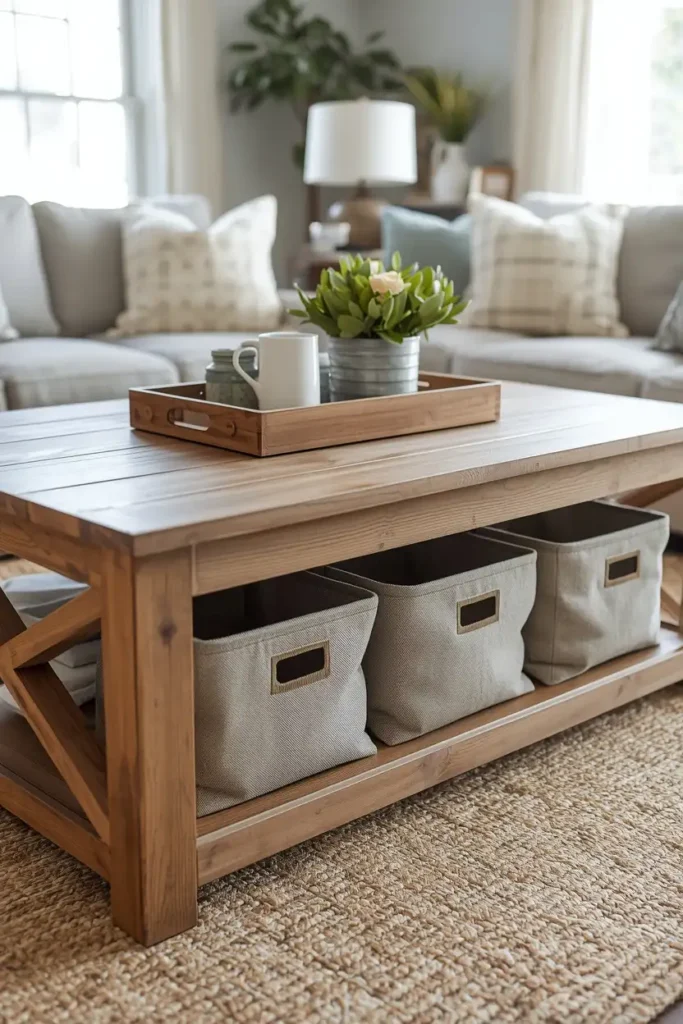
Imagine walking into a warm, farmhouse-style living room where the coffee table’s open base holds three woven fabric bins, each one hiding a different category of household clutter.
Design Breakdown
This build uses a simple X-brace or slatted wood frame with a lower shelf sized specifically to fit standard fabric storage bins. The bins slide in and out easily, giving you closed storage without any hardware like hinges or slides.
Expert Tip
Measure your bins before building the shelf. Standard fabric bins vary in size by an inch or two between brands, and a shelf built too tight will make bins impossible to remove smoothly.
Why It Works
Fabric bins add warmth and texture while fully concealing clutter, which makes this one of the easiest storage upgrades for anyone who doesn’t want to deal with drawer hardware.
Best For
- Families
- Budget makeovers
- Renters
Common Mistake To Avoid
Using bins with mismatched patterns or colors — stick to one cohesive set for a pulled-together look.
Quick Wins
- No hardware or hinges needed
- Adds cozy, farmhouse-style texture
- Great for hiding kids’ toys and pet supplies
- Bins are removable for easy cleaning underneath
Related Coffee Table and Living Room Storage Ideas
If you’re loving these ideas, don’t stop here. Keep exploring — there’s a whole world of small-space and storage-focused inspiration waiting for you.
- Space-Saving Furniture Ideas
- Small Console Tables Ideas
- TV Table Ideas
- Clothes Storage Ideas
- Documents Organization Ideas
- Garage Organization Ideas
- 20 Brilliant DIY IKEA Dresser Hacks
- Cabinet Makeover Ideas
Final Thoughts on DIY Coffee Table with Storage Ideas
If there’s one thing to take away from this list, it’s this: the best DIY coffee table with storage ideas aren’t about building the fanciest piece of furniture you can. They’re about matching the storage style to how you actually live.
If your biggest battle is remotes and mail, a drawer-front build or slide-out rack solves it in a weekend. If you’re constantly stepping over blankets and toys, an ottoman-style or fabric bin design will make the biggest difference. And if you just want an easy win without picking up a saw, that vintage trunk idea might be your fastest path to a completely different-feeling living room.
Here’s my honest advice: don’t try to tackle all ten. Pick one idea from this list, and commit to building or sourcing it this week. Small, finished projects beat big, unfinished ones every time.
So — which of these ideas would work best in your home?
If storage isn’t your only concern and you’re also thinking about the bigger picture of your living space, our living room remodel ideas guide is a natural next stop.
And if you’re curious what’s coming next, keep an eye out for our upcoming guide on small-space furniture hacks that go far beyond the coffee table — it might just change how you think about every room in your home.
Frequently Asked Questions About DIY Coffee Table with Storage Ideas
1. What is the easiest DIY coffee table with storage to build for beginners? The lift-top coffee table and the fabric bin storage design are both beginner-friendly since they require minimal hardware and basic tools.
2. How much does it cost to build a DIY storage coffee table? Most builds range from $60 to $280 depending on materials and storage style, with basic crate-style tables on the lower end and drawer-front builds on the higher end.
3. What wood is best for a DIY coffee table? Pine and plywood are popular for budget builds, while oak or walnut suit those wanting a higher-end, furniture-store look.
4. Can I turn an old coffee table into a storage table? Yes — adding a fabric skirt, bins, or a hinged lift-top to an existing table is one of the fastest and cheapest storage upgrades.
5. What’s the best coffee table storage solution for small apartments? Nesting tables with individual bins or a slim slide-out rack tend to work best since they add storage without taking up extra floor space.
6. Are lift-top coffee tables sturdy enough for daily use? Yes, as long as you use quality hinges and support struts, lift-top tables hold up well to regular use, including as a laptop surface.
7. How do I hide clutter on an open-shelf coffee table? Use matching baskets or fabric bins to create a cohesive, intentional look instead of leaving loose items visible.
8. What tools do I need for a basic DIY coffee table build? A drill, circular or hand saw, sander, measuring tape, and wood screws will cover most beginner builds on this list.
9. Is a vintage trunk a good alternative to building a coffee table? Absolutely — it requires no woodworking and offers generous storage with built-in character, making it ideal for renters and budget makeovers.
10. How do I choose the right coffee table storage style for my living room? Think about what actually clutters your space most often. Loose items suggest closed storage like drawers or bins, while decor-forward homes may prefer open shelving.