10 Effective Documents Organization Ideas That Will Change Your Life
This article was created in line with Trends Oraa’s research and content standards.
You know that panic when you need an important paper right now and you can’t find it anywhere? Yeah. That feeling is completely avoidable.
If paper chaos is silently stressing you out every single day, you are in exactly the right place. This guide covers 10 genuinely effective documents organization ideas that will help you finally get your paper piles, files, and folders under control — for good.
And trust me, once you see idea #7, you’ll wonder how you ever lived without it.
You might also love our viral guide on 10 Useful IKEA Hacks to Keep Your Home Organized — it pairs perfectly with this one!
We’ve seen so many people stress over lost warranties, misplaced tax forms, and buried medical records. The good news? A little system goes a long way. Whether you’re a total minimalist or you love a good label maker moment, these ideas will meet you right where you are.
Let’s get into it.
1. The Color-Coded Accordion File System
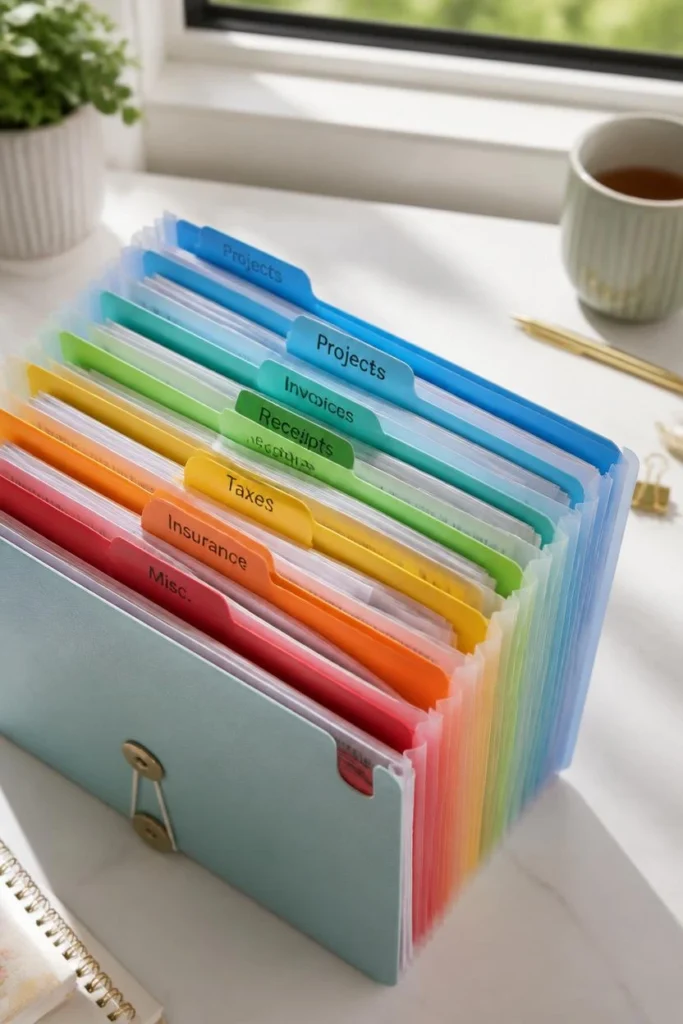
Picture this: a sleek, expandable accordion file sitting on your desk, each pocket tagged with a bright, color-coded label. One color for finances, one for medical, one for home documents, one for kids’ school papers — you get the idea.
This is one of the most beginner-friendly documents organization ideas out there, and it works immediately. The color system removes the need to read every label. Your brain recognizes color faster than text, so you can grab what you need in under ten seconds.
Expert Tip: Use sticky labels with a different color per category and keep the accordion file in an accessible drawer rather than a cabinet. The easier it is to reach, the more likely you are to actually use it. Pair this with a simple rule: every piece of paper gets filed the same day it enters your home.
Why it works: Color coding creates a visual map in your brain. The moment you see it, you already know where everything lives. It also makes returning documents to their place completely intuitive, which means your system stays organized even when life gets busy.
2. The Binder-Per-Category Method
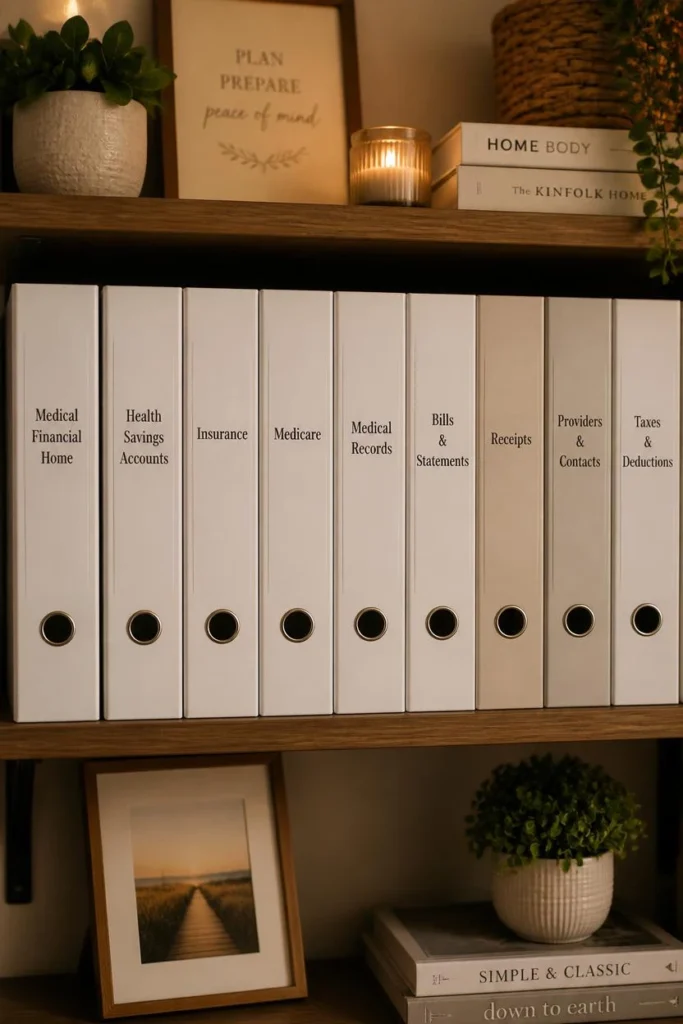
Think of a row of matching binders on a shelf — labeled clearly, each one housing a specific area of your life. One binder for car documents, one for insurance, one for medical records, one for warranties and receipts. Each binder gets tabbed dividers inside, and suddenly you have a personal filing office right on your bookshelf.
This is one of the most satisfying documents organization ideas because it’s highly visual. When everything is spine-out and labeled, you can scan your entire collection in one glance.
Expert Tip: Use matching binders in a consistent color or neutral tone to keep the shelf looking polished. Sheet protectors inside each binder will protect important documents from wear, spills, or smudging over time. Write the date range on each binder’s spine — for example, “Medical 2023–2025” — so you always know what’s current and what can be archived.
Why it works: Binders are modular. You can add, remove, or reorganize pages without disturbing the rest of your system. They’re also thick enough to hold a full year (or more) of documents, making them ideal for ongoing categories like finances or health records.
Which of these document organization styles fits your personality best — the colorful accordion file or the classic binder row? Drop your answer in the comments!
3. The Vertical Wall-Mounted File Organizer
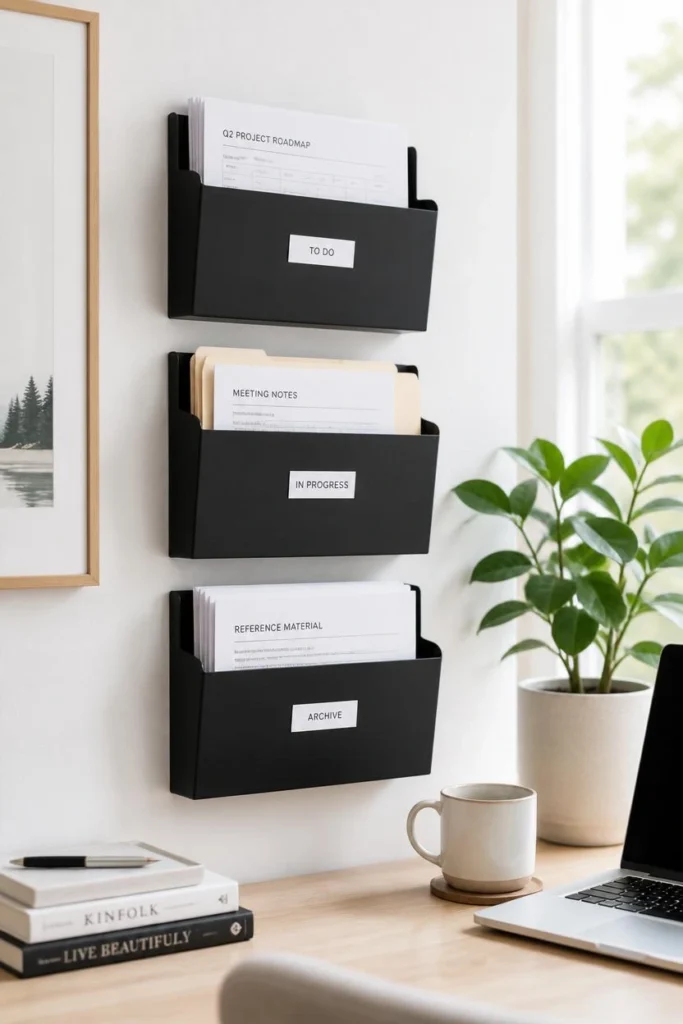
Here’s where it gets interesting. Most people think of document storage as something that goes inside a drawer or cabinet. But vertical wall-mounted organizers flip the script entirely.
Imagine a set of metal or acrylic wall pockets mounted near your entryway or home office desk. Each slot holds a category: incoming mail, bills to pay, documents to file, school papers, and miscellaneous. Papers never pile up on the counter because there’s a designated home for everything — literally on the wall.
Expert Tip: Mount your organizer at eye level so it’s always in your line of sight. Out of sight truly does mean out of mind when it comes to paperwork. Label each slot clearly and commit to a weekly “filing Friday” habit where you move items from the wall to their permanent storage spot.
Why it works: Wall-mounted systems work because they interrupt the habit of setting papers down anywhere. They create a visual queue — you can see when a slot is getting full, which cues you to take action before things get overwhelming.
4. The Digital Scanning + Cloud Backup System
But here’s the important part — paper isn’t the only way to store documents anymore, and relying on it exclusively is a risk. A house fire, flood, or simple misplacement can wipe out years of irreplaceable records.
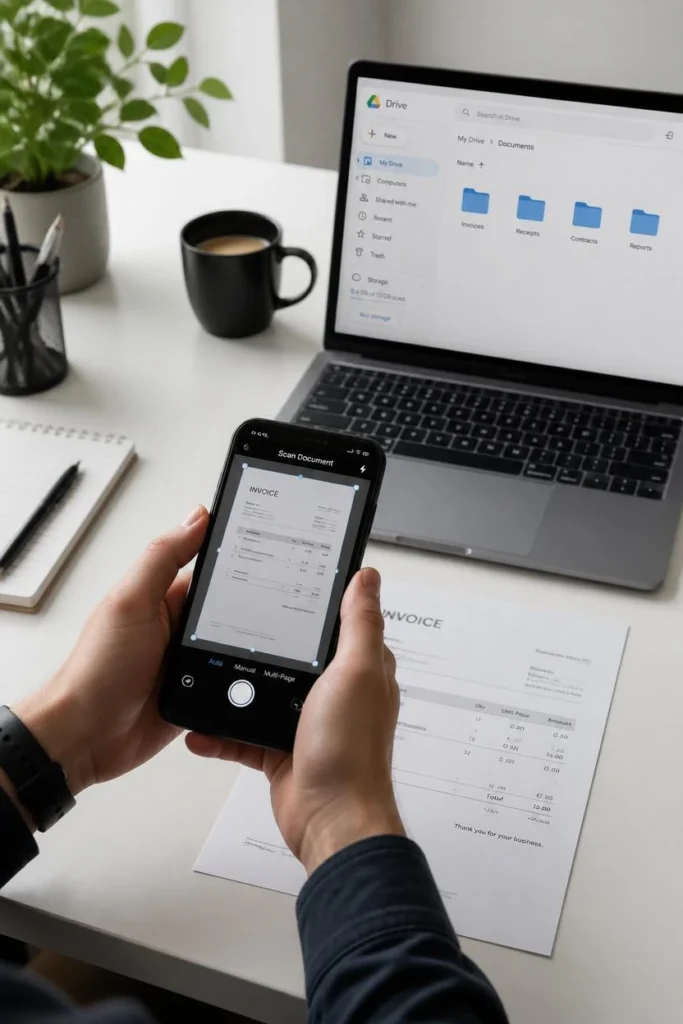
A digital scanning system involves scanning every important document with a free app like Adobe Scan or Microsoft Lens, then uploading it to a cloud folder (Google Drive, Dropbox, or iCloud). Create clearly named folders that mirror your physical filing system — Medical, Financial, Home, Legal — and you’ll have a searchable backup accessible from anywhere.
Expert Tip: Make it a habit to scan documents the same day you receive them. The two-minute rule applies perfectly here — if it takes less than two minutes, do it now. Name your files descriptively (e.g., “HomeInsurance_Renewal_2025”) rather than leaving them as scanner defaults, so you can find them instantly with a search.
Why it works: Digital backups remove the single point of failure that all-paper systems have. They also allow you to search for a document by keyword in seconds rather than digging through folders. For anyone who works from home or travels often, this system is non-negotiable.
Deep Dive: Documents Organization Buying Guide
Before you invest in any supplies, it helps to know what’s actually worth buying versus what’s just pretty-looking clutter. Here’s an honest breakdown.
What to look for in a filing system:
- Durability first. Cheap accordion files fall apart within a year. Look for thick polypropylene plastic or reinforced cardboard.
- Clear labeling capacity. Every organizer should have a place for a visible label. If you have to guess what’s inside, the system will fail.
- Scalability. Can you add to it? A system you grow out of in six months isn’t a real solution.
- Accessibility. The best filing system is the one you’ll actually use. If it’s locked in a cabinet in another room, it won’t work.
Budget Breakdown:
- $0–$10: Basic accordion folders, simple manila envelopes, free digital scanning apps — great for starting out or testing a system before committing.
- $10–$30: Quality binders with dividers, tabbed folders, wall-mounted organizers from IKEA or Amazon — the sweet spot for most households.
- $30–$80: Matching binder sets, desktop file boxes, premium hanging file systems, label makers — ideal for home offices or anyone managing a lot of paperwork.
- $80+: Fire-safe document boxes, locking filing cabinets, dedicated document scanners — worth it for legal documents, passports, deeds, or irreplaceable records.
Pros and Cons at a Glance:
Paper systems: Easy to set up, no tech required, universally accessible — but vulnerable to damage, takes physical space, and harder to search.
Digital systems: Searchable, backed up, accessible anywhere — but requires consistent habits, tech literacy, and a stable internet connection.
Hybrid systems (both): The most resilient option — combines the accessibility of physical storage with the security of digital backup.
Most people do best with a hybrid approach: physical files for things you reference often, digital backups for everything important.
5. The Hanging File Drawer System
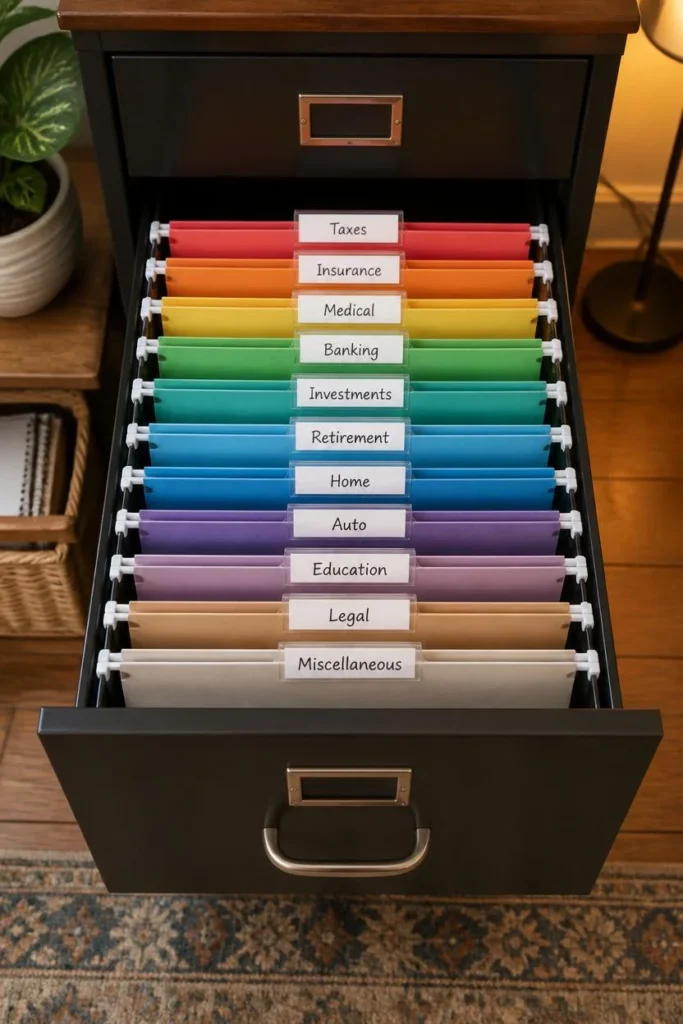
Nothing says “I have my life together” quite like opening a drawer and seeing a neat row of color-tabbed hanging files standing at attention. This is the classic home office documents organization idea — and it’s classic for a reason.
A standard filing cabinet or desktop file box holds hanging folders, each labeled with a major category. Inside each hanging folder, you can add standard manila folders for subcategories. For example, the “Medical” hanging folder might contain individual folders for each family member.
Expert Tip: Invest in pre-printed label sets or a Brother label maker to keep all your tabs consistent. Handwritten labels become messy and hard to read over time, which subtly discourages you from maintaining the system. Also, never overcrowd a drawer — when folders are crammed in, you stop using them.
Why it works: The hanging file system is one of the most ergonomic ways to organize documents because files stay vertical and visible. You never have to lift a pile to see what’s underneath. It also scales beautifully — add more folders as your life grows without reorganizing everything.
6. The “Action Required” Tray System
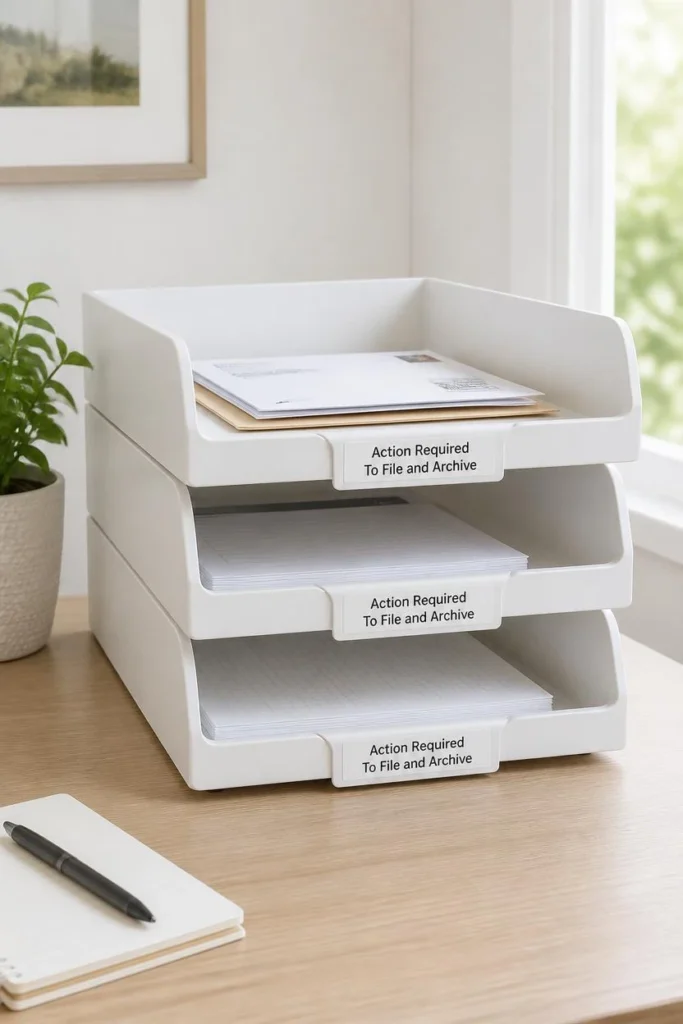
Most people don’t know this — but the reason most paper piles exist isn’t a lack of storage. It’s a lack of an “in-between” home for documents that need action before they can be filed.
A simple three-tray desktop system solves this immediately. Label the trays: Action Required, To File, and Archive. Papers move through the trays in order. Unopened mail and bills go in Action Required. Once handled, they move to To File. Once filed, they’re done.
Expert Tip: Keep the Action Required tray visible and within arm’s reach of wherever you sit down to handle mail or pay bills. The more friction you remove between “receiving a document” and “putting it somewhere logical,” the less likely it is to become a pile.
Why it works: The tray system works because it acknowledges the reality of how paperwork actually moves through a household. Not everything can be filed immediately — and a dedicated holding zone prevents the default “pile on the counter” behavior that derails most organization systems.
Have you tried a tray system before? What stopped it from working — tell me in the comments and let’s troubleshoot together!
7. The Labeled Clear Box Archive System
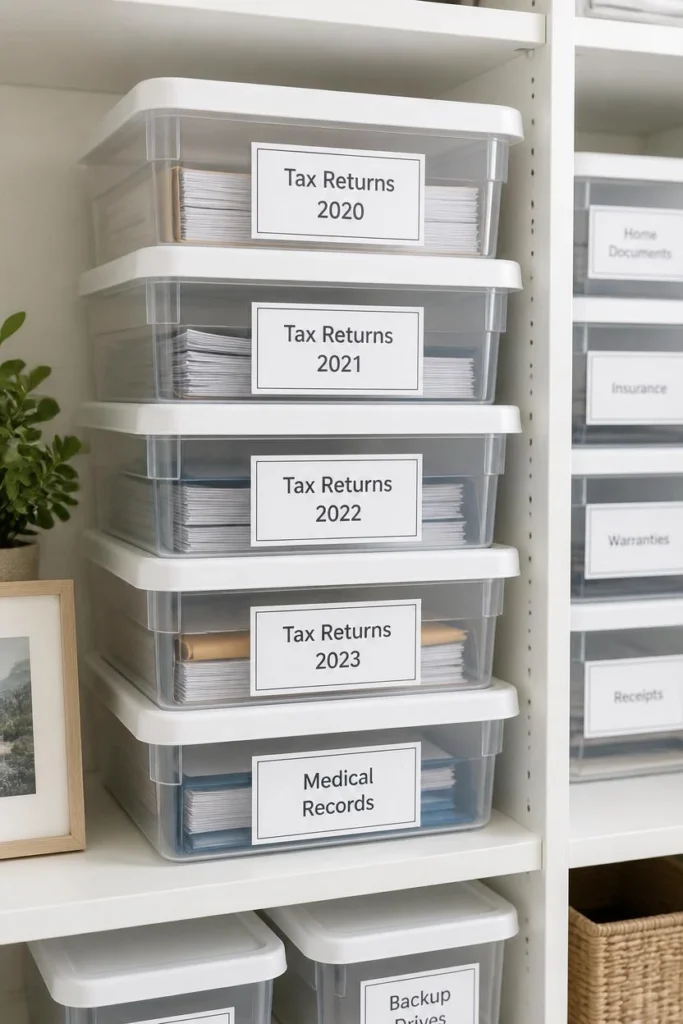
Now, avoid this mistake: burying documents you don’t need often in the same space as things you access weekly. Mixing active files with long-term archives is one of the fastest ways to create chaos.
Clear plastic boxes with lids — the kind you can stack in a closet — are perfect for document archiving. Label the outside clearly (“Tax Returns 2019–2022,” “Old Medical Records,” “Car History”) and stack them on a shelf or in a closet. You never need to open them regularly, but when you do need them, you’ll know exactly where to look.
Expert Tip: Use a waterproof marker on labels and add a simple inventory list inside the lid. Every two or three years, do an audit — shred what’s no longer needed and combine boxes to free up space. Keep a separate “current year” box on your desk that gets transferred to the archive at year’s end.
Why it works: Archived document boxes create a physical boundary between active paperwork and historical records. Your everyday workspace stays clean, your brain stays calm, and your long-term records are safe, labeled, and out of the way.
8. The Expandable Envelope System for Receipts and Small Papers
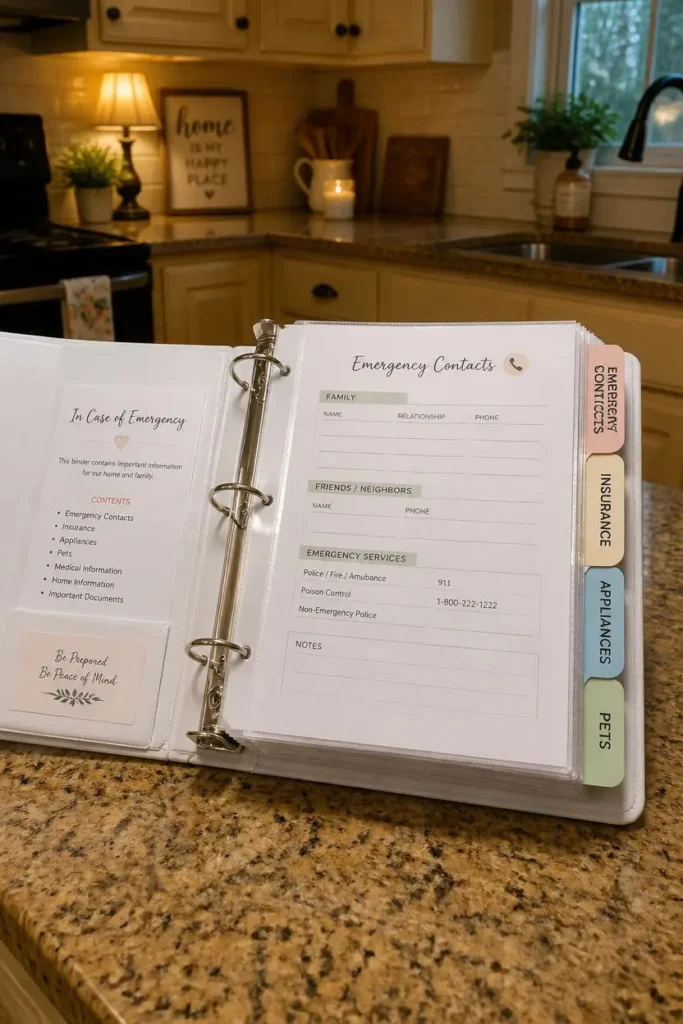
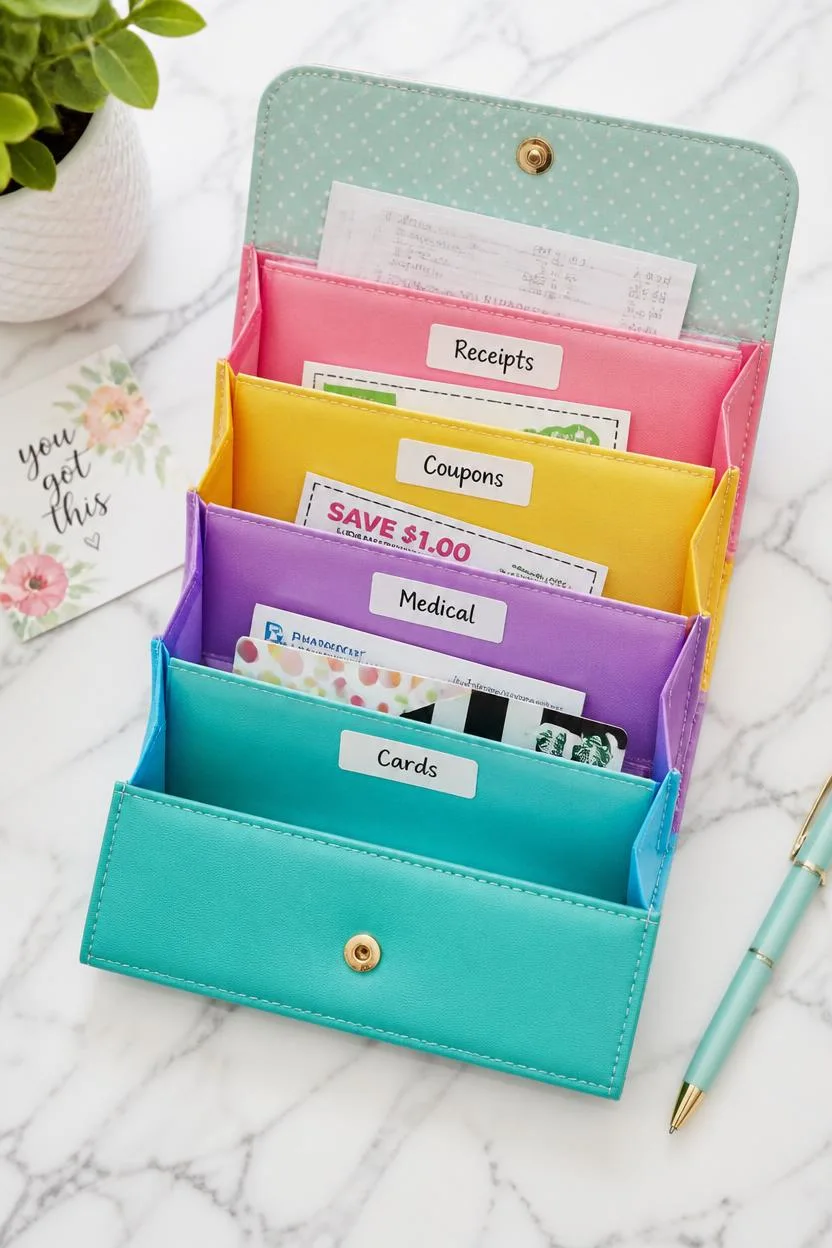
Receipts. Coupons. Insurance cards. Random cards with phone numbers. These tiny paper pieces fall through the cracks of most organization systems — and then you desperately need one and can’t find it.
Expandable envelopes with multiple pockets (often sold as budgeting envelopes) are perfect for this. Keep one in your bag and one at home. Label each pocket with a category: Receipts, Coupons, Medical Cards, Gift Cards, Miscellaneous. When something small comes in, it has a home instantly.
Expert Tip: Go through your portable envelope once a week and transfer anything important to your main filing system. Anything you don’t need anymore gets shredded or recycled immediately. The goal of this system is to be a temporary catch-all, not a permanent home.
Why it works: Small papers are uniquely problematic because they don’t fit neatly into standard files and they’re easy to “set down for a second.” Having a dedicated small-paper system removes that problem entirely. It’s one of the most underrated documents organization ideas on this list.
9. The Household Command Binder
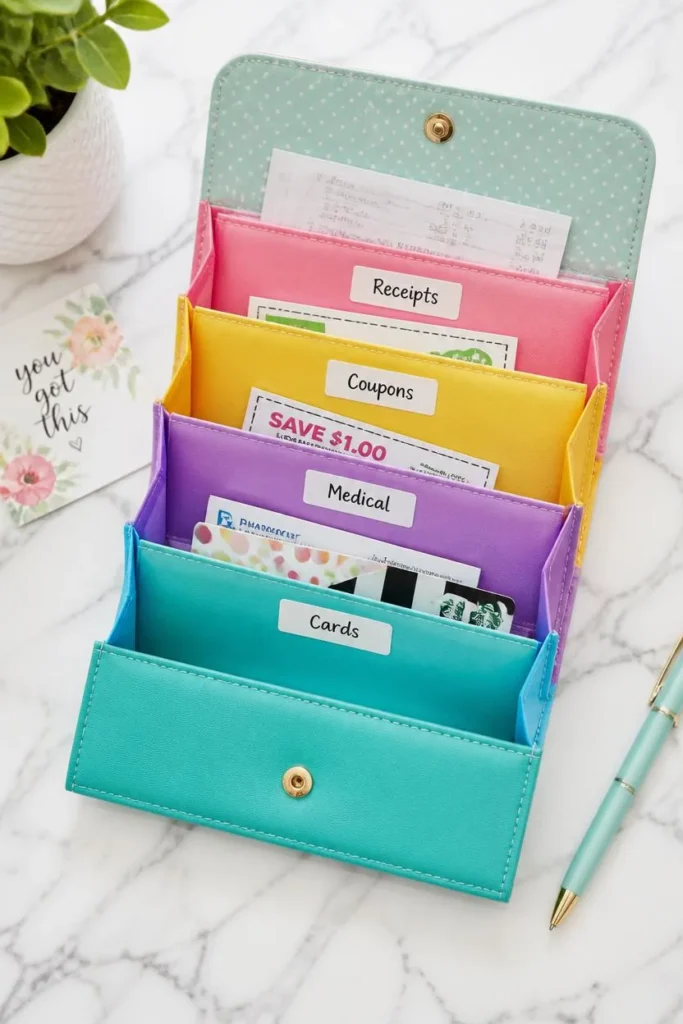
Here’s where it gets really good. Imagine one single binder that holds every piece of information a house needs to run: emergency contacts, insurance policy numbers, appliance manuals, contractor info, pet records, medication lists, subscription info, and more.
A Household Command Binder is less about filing individual documents and more about creating a master reference guide for your entire home life. Divide it into sections with labeled dividers, and keep it somewhere every household member can access — like a kitchen shelf or home office bookcase.
Expert Tip: Include a “who to call” section at the front — plumber, electrician, vet, pediatrician, insurance agent. This section alone will save you frantic Google searches during the worst moments. Review and update the binder every January as part of a “new year home refresh.”
Why it works: The command binder works because it consolidates all the information you need to manage a household in one place, separate from the documents you need to store. These are two different needs, and treating them separately makes both systems work better.
10. The Minimalist One-Box Capsule Filing System
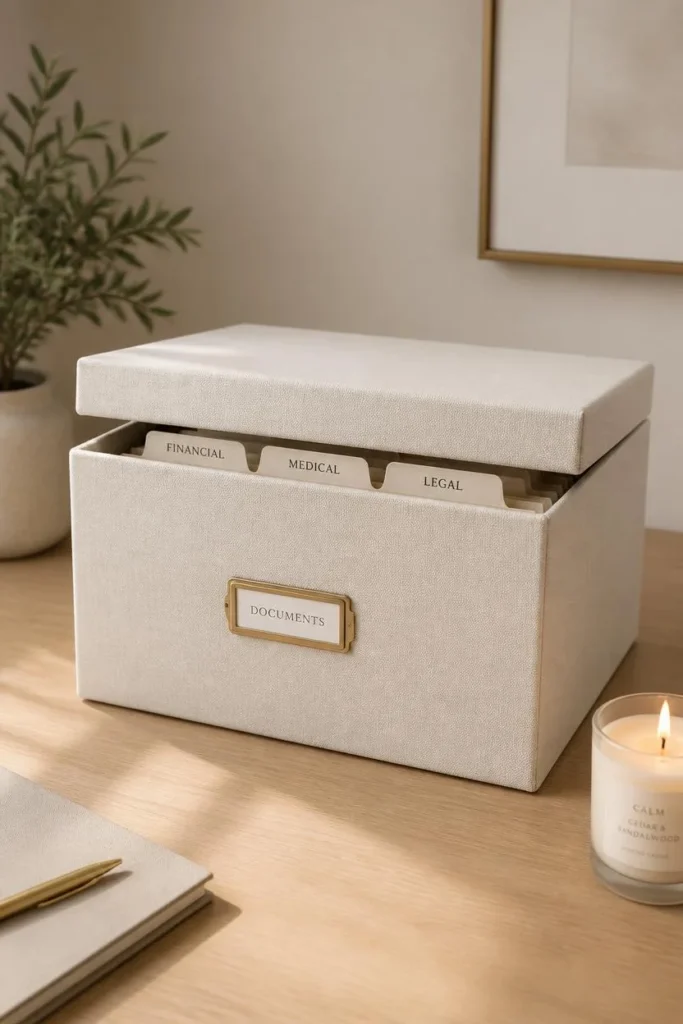
Most people don’t know this — but you probably have far fewer documents worth keeping than you think. The minimalist approach challenges you to question every piece of paper before it earns a spot in your system.
The capsule filing system uses a single beautiful box (think a lidded document box from IKEA or The Container Store) with just a few essential folders inside: Active, Financial, Medical, Home, Legal. That’s it. Every document must fit into one of those five categories or it gets shredded.
Expert Tip: Before adding any document to the box, ask yourself: “Would I need this in the next five years, and can I get it again digitally if needed?” If the answer is no, it doesn’t go in. This keeps your system from becoming bloated over time and makes it genuinely effortless to maintain.
Why it works: Constraint is a feature, not a bug. When your system is small enough to manage, you’ll actually maintain it. A one-box system that gets used every week beats a fancy filing cabinet that collects dust every time.
Which of these 10 documents organization ideas are you most excited to try? I’d love to know — comment below with your number!
You’ve Got This — Here’s What to Do Next
Look, getting your documents organized isn’t about having the fanciest system or the most Pinterest-worthy setup. It’s about finding one method that clicks with your brain and committing to it.
Start with just one idea from this list. Pick the one that felt most exciting to you when you read it — that’s usually your gut telling you it’s the right fit. Set up your system this weekend, spend ten minutes filing what’s already piling up, and then commit to a five-minute weekly maintenance habit.
The relief you’ll feel when you can find any document in under 60 seconds? Absolutely worth it.
And if you’re on a roll with home organization, you will absolutely love this next one — check out our complete guide on Apartment Organization Ideas for even more smart, space-saving solutions that work in any home.
You’re already doing the hard part by just being here. Now go make your home feel a little lighter.