10 Living Room Lighting Ceiling Ideas That Will Transform Your Space Tonight
This article was created in line with Trends Oraa’s research and content standards.
Your ceiling is lying to you.
It’s pretending to be invisible — just a blank surface you glance past every single day.
And that’s exactly why your living room never feels as warm, polished, or magazine-worthy as you want it to.
The truth is, living room lighting ceiling ideas are the single most overlooked design upgrade in any home. The right ceiling light doesn’t just illuminate a room — it sets the entire mood, makes your space feel bigger (or cozier), and ties every single design element together.
The good news? You don’t need a contractor or a huge budget to make a dramatic change.
You might also love our guide on High Ceiling Living Room Ideas — the perfect companion read if you’re working with volume overhead.
In this post, I’m walking you through 10 stunning ceiling lighting ideas that work for every style, every budget, and every room size. Stick around — because a few of these will genuinely surprise you.
10 Living Room Lighting Ceiling Ideas Worth Stealing
1. The Layered Chandelier + Recessed Combo
What You’re Seeing
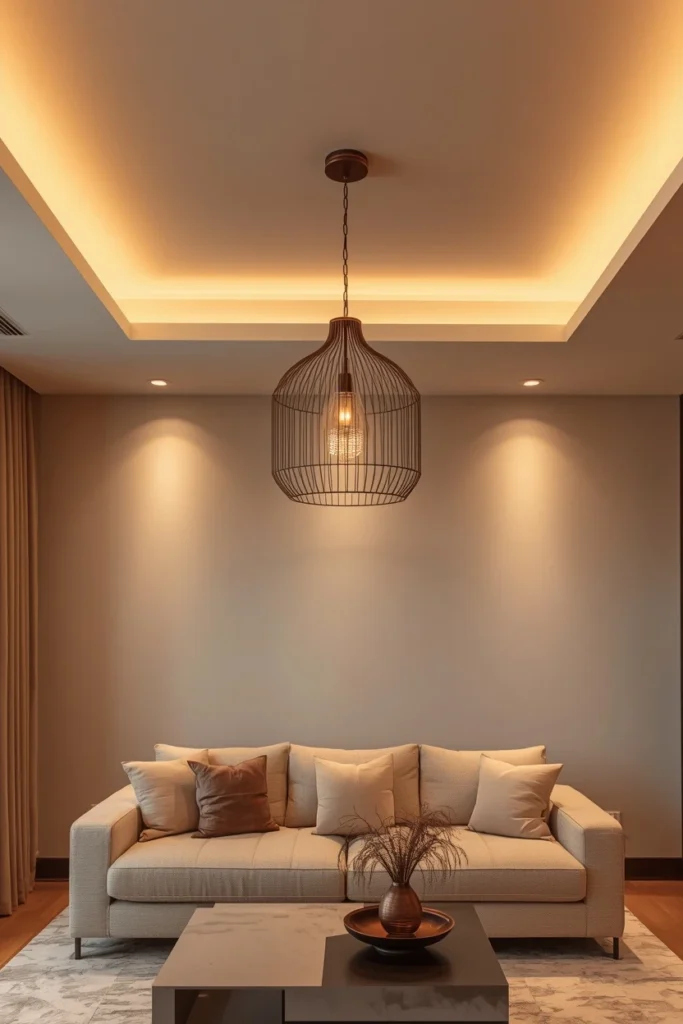
Picture a warm, modern living room anchored by a sculptural bronze chandelier hanging at the center — maybe with exposed Edison bulbs or a cage-style frame. Surrounding it, a ring of flush recessed lights are spaced evenly across the ceiling, creating a halo effect of ambient light. The room feels intentional, layered, and undeniably luxurious.
Design Breakdown
This approach is called layered lighting, and it’s how interior designers approach every living room ceiling they work on. The chandelier acts as the statement piece — the focal point that says “this room was designed, not decorated.” The recessed lights handle the heavy lifting, flooding the room with adjustable ambient illumination.
Together, these two elements give you the ability to dial in the exact mood you want. Bright and practical for movie night with the kids? Recessed on full. Romantic dinner party feel? Dim everything down and let the chandelier glow.
Expert Tip
Use a dimmer switch for both circuits. LUTRON makes excellent ones that work with LED bulbs. This alone upgrades the feel of your entire room without touching the fixtures.
Why It Works
Psychologically, the chandelier draws the eye upward, making ceilings feel taller. Functionally, the recessed lights eliminate shadows and dead zones. Aesthetically, the combination reads as curated and high-end — even on a modest budget.
Best For
- Large spaces
- Luxury homes
- Open floor plans
Common Mistake to Avoid
Hanging the chandelier too high. A chandelier should hang about 7 feet from the floor in a living room — not pressed up against the ceiling.
Quick Wins
- Choose a chandelier 12 inches narrower than your sofa width
- Install on separate dimmer circuits
- Use warm-white bulbs (2700K–3000K) for a cozy feel
- Make sure your ceiling can handle the fixture’s weight before installing
2. Cove Lighting Along the Ceiling Perimeter
What You’re Seeing
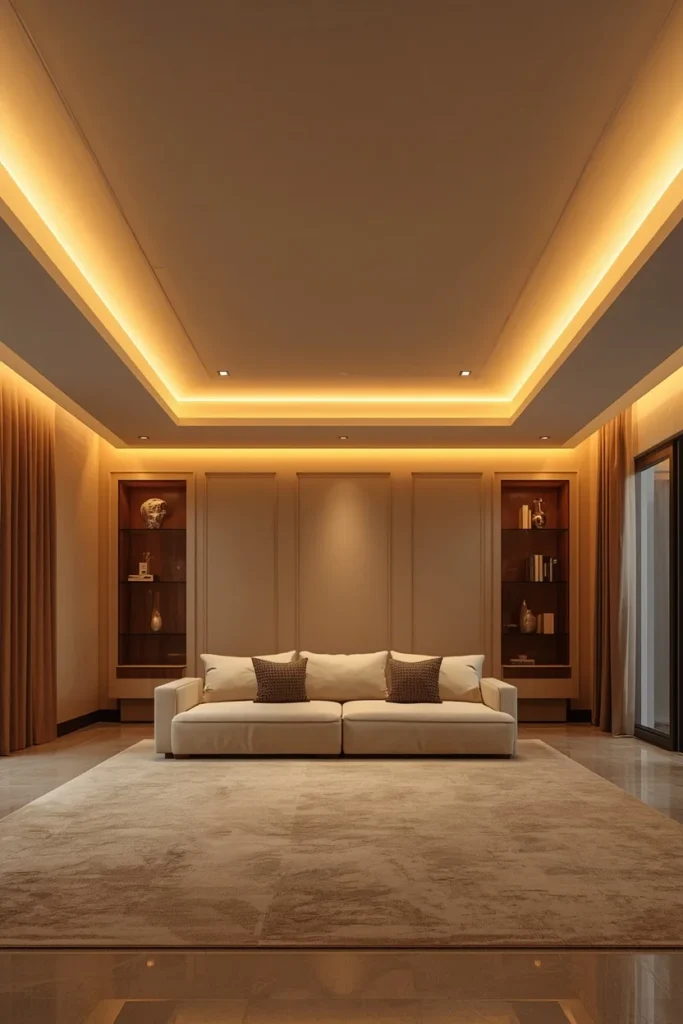
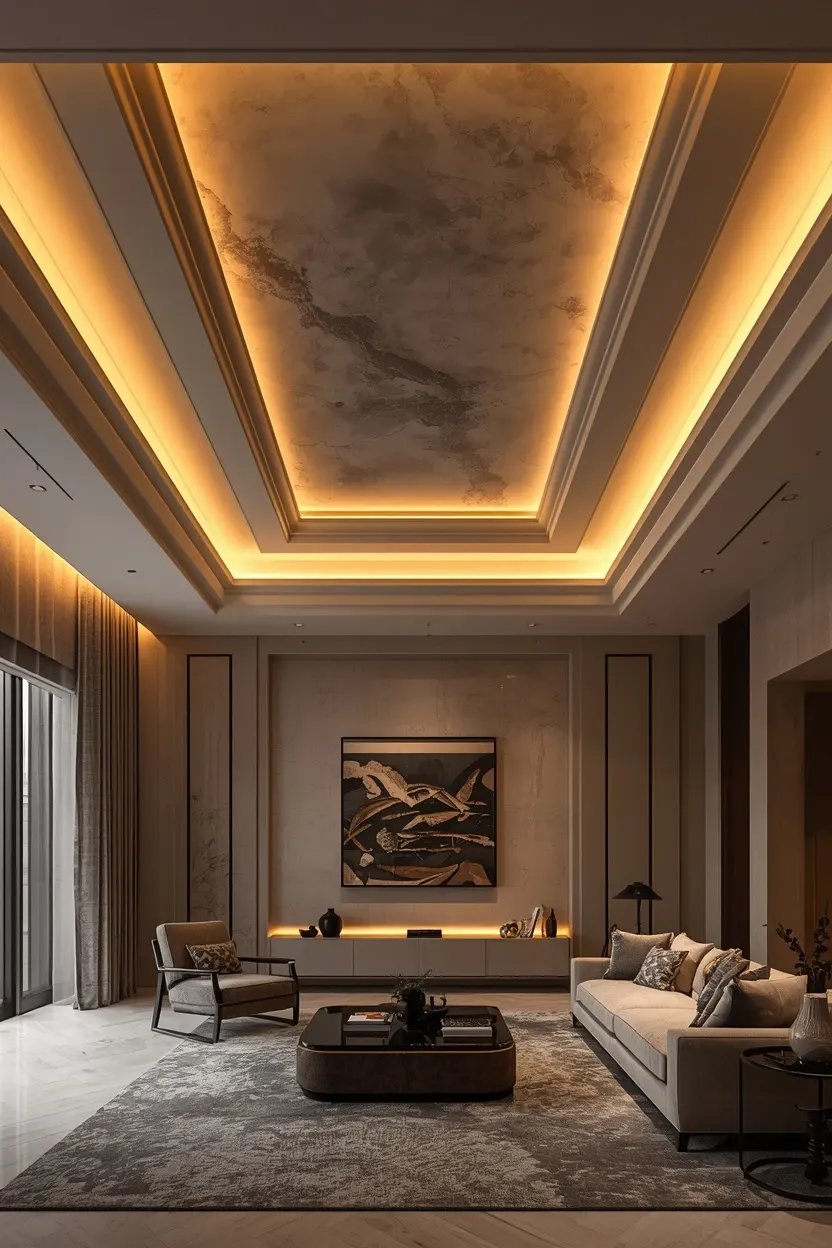
Imagine a living room where the ceiling seems to float. Soft, golden light glows from a hidden ledge built into the ceiling perimeter — no visible bulb, no fixture, just a wash of warm light that traces the entire room. It looks like something from a luxury hotel suite.
Design Breakdown
Cove lighting uses LED strip lights concealed inside a recessed ledge or tray built along the edge of the ceiling. The light bounces off the ceiling rather than shining directly downward, which creates an incredibly diffused, flattering glow.
This technique is a favorite of architects and high-end designers because it adds architectural interest without adding clutter. It’s especially powerful in rooms with tray ceilings — but you can DIY a simplified version even without one using shallow crown molding and LED strips.
Expert Tip
Use RGBWW (red, green, blue, warm white) smart strips that connect to apps like Govee or Philips Hue. This lets you change the color temperature from warm amber to cool white depending on the time of day — or even create color scenes for mood.
Why It Works
Indirect ceiling light is the most flattering kind — it softens shadows, reduces glare, and makes everyone in the room look better. It also creates depth and dimension that flat overhead lighting simply can’t match.
Best For
- Large and medium spaces
- Luxury homes
- Renters (peel-and-stick LED strips need no permanent installation)
Common Mistake to Avoid
Using cool-white or blue-tinted LEDs for cove lighting. It creates a harsh, clinical feel. Always go warm (2700K–3000K).
Quick Wins
- Pair with a statement ceiling fan for dual function
- Use a smart controller for scene presets
- Run the strip along at least three sides of the room for a balanced look
- Diffuse with a small lip of molding to hide the strip entirely
Most people don’t know this: The color temperature of your light bulbs has a bigger impact on how a room feels than the style of the fixture itself. A $15 LED strip at 2700K will feel warmer and more inviting than a $500 chandelier fitted with 5000K daylight bulbs. Always choose your bulbs before your fixtures.
3. Flush Mount Drum Shade in a Statement Finish
What You’re Seeing
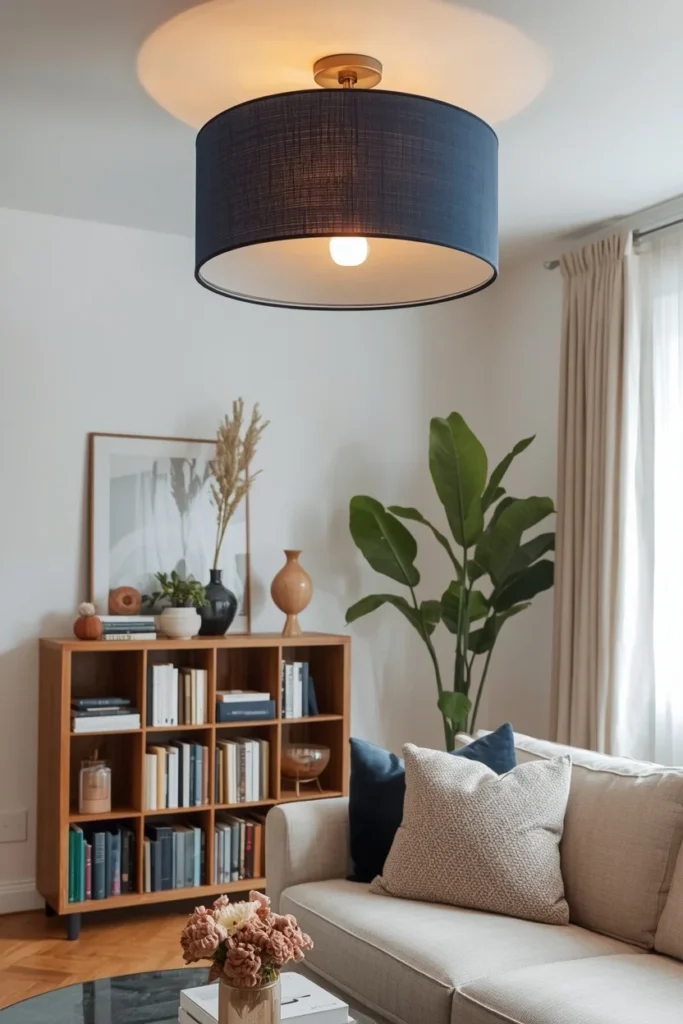
A wide, low-profile drum shade fixture — maybe in a rich navy, forest green, or matte black — sits flush against the ceiling of a cozy, well-styled living room. It’s simple, grounded, and surprisingly powerful as a design statement.
Design Breakdown
Drum shade flush mounts are having a major moment right now, and for good reason. They work in almost any ceiling height, they’re available in virtually every style and price point, and they do something most ceiling lights can’t: they add color and texture to the top of the room.
A fabric drum in a deep jewel tone adds softness. A woven rattan drum brings warmth and texture. A ribbed glass drum diffuses light beautifully while nodding to vintage design. This is one of the most versatile living room lighting ceiling ideas on this list.
Most people waste more space than they realize — including the ceiling. A well-chosen flush mount can anchor a room just as effectively as a chandelier.
Expert Tip
Measure your room and choose a drum shade diameter that’s about one foot per 10 square feet of floor space. A 150-square-foot room needs a fixture around 15 inches in diameter.
Why It Works
The drum shape provides 360-degree light diffusion, eliminating harsh shadows. The close-to-ceiling profile keeps sightlines clean in lower-ceilinged rooms. And the decorative finish gives the room a designed, layered feel without requiring a major renovation.
Best For
- Small spaces
- Apartments and rentals
- Budget makeovers
- Families with young children (no dangling parts)
Common Mistake to Avoid
Going too small. A drum shade that’s too petite disappears visually and doesn’t provide enough light. When in doubt, size up.
Quick Wins
- Choose a shade in a color that echoes an accent in the room
- Layer with floor lamps for full ambient coverage
- Install on a dimmer for evening flexibility
- Look for semi-flush options if you have a little ceiling clearance
You May Also Like:
- Living Room Chandelier Ideas
- Modern Chandelier Ideas
- Cozy Living Room Ideas
- Modern Dark Living Room Ideas
- Bedroom Ceiling Ideas
4. Exposed Beam Lighting with Edison Bulb Pendants
What You’re Seeing
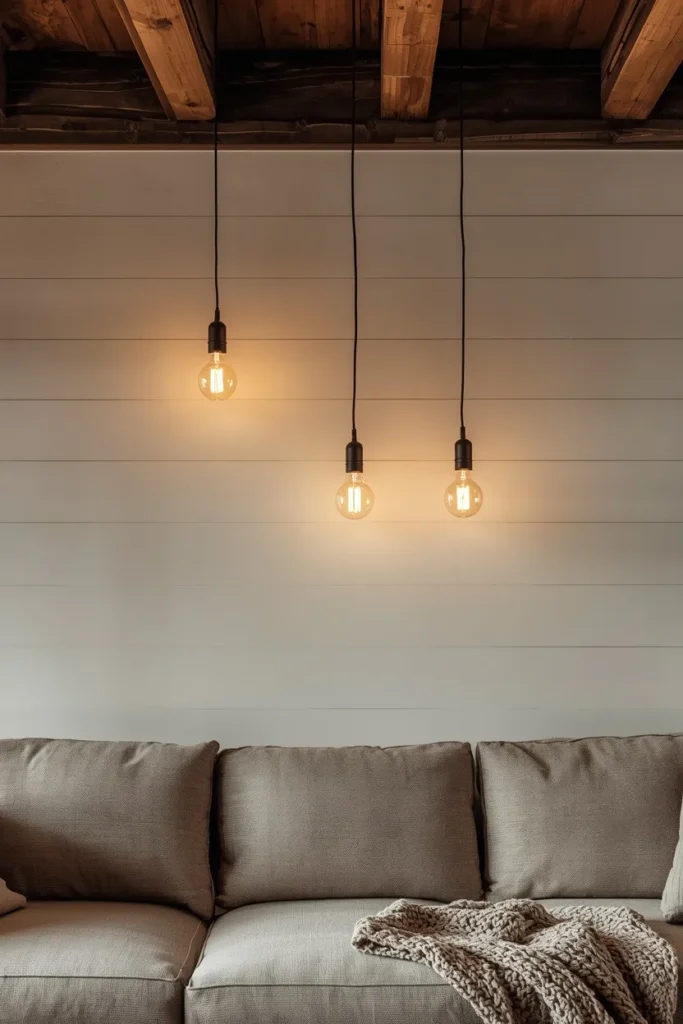
Dark, rustic ceiling beams run horizontally across a warm living room. Between them — or hanging directly from them — are a series of Edison bulb pendants at varying heights. The effect is industrial-farmhouse, wildly photogenic, and endlessly warm.
Design Breakdown
If your home has actual exposed beams, you’re sitting on a goldmine of design potential. Pendant lights hung from beams create instant architectural character. You can cluster them for drama or space them evenly for a more refined look.
No beams? You can install faux beam kits — they’re hollow wood sleeves that attach directly to your ceiling without structural work. Combine them with surface-mounted pendant cord kits and you’ve got the look for under $300.
Expert Tip
Vary the drop lengths of your pendants. Having all three at the exact same height looks flat. Stagger them at 6-inch intervals for a more organic, collected feel.
Why It Works
Edison bulbs emit a warm amber glow (typically 2200K) that mimics candlelight. That color temperature triggers a sense of relaxation and comfort. Combined with the organic texture of wood beams, the result is a room that feels deeply livable.
Best For
- Farmhouse, rustic, or industrial styles
- Large living rooms with high ceilings
- Homes with existing exposed beam structure
Common Mistake to Avoid
Using LED Edison bulbs that are too bright. Look for options rated at 40W equivalent or lower for that authentic, moody glow.
Quick Wins
- Use an odd number of pendants (3 or 5) for visual balance
- Choose bulbs between 2200K–2400K for maximum warmth
- Match hardware finish to other metal accents in the room
- Consider plug-in pendant kits — no electrician required
5. The Geometric Statement Ceiling Light
What You’re Seeing
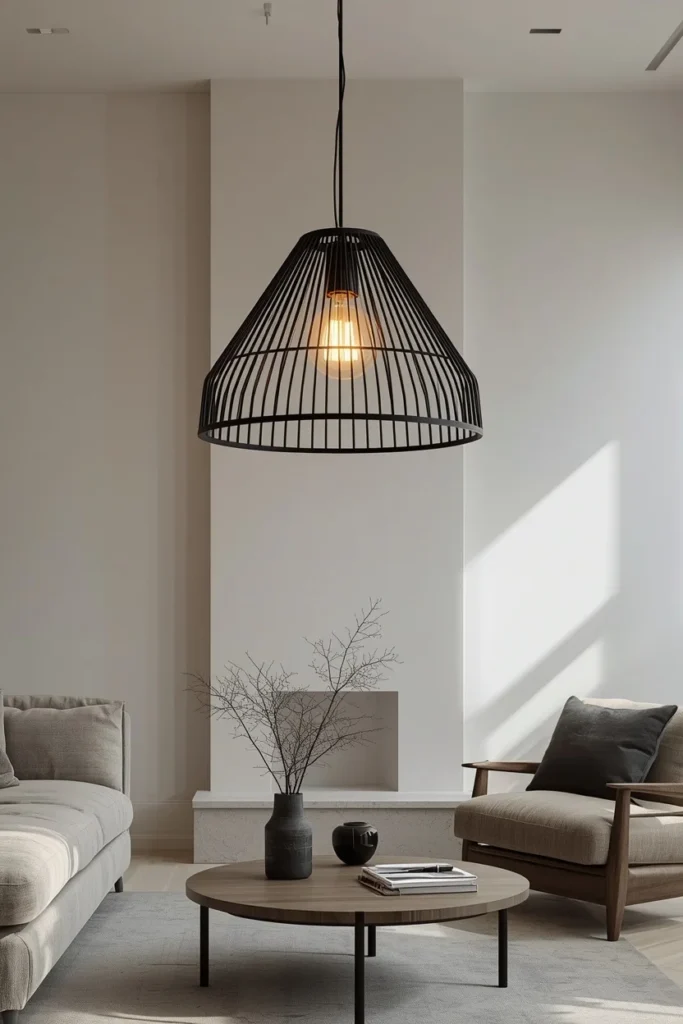
An oversized geometric pendant — maybe a hexagonal cage, a sculptural dome, or an origami-folded shade — commands the center of a modern or transitional living room. Everything else in the space is deliberately understated to let this fixture shine.
Design Breakdown
Geometric ceiling lights are one of the most Pinterest-loved living room lighting ceiling ideas for a reason: they’re bold, architectural, and work across multiple styles. A black cage geometric reads as industrial. A white papery origami fold reads as Scandinavian. A brass wireframe reads as glamorous and modern.
The key is treating the fixture like art. One showstopper piece, properly centered, does more for a room’s visual identity than a dozen small decorative touches.
Expert Tip
Hang a geometric pendant at least 30 inches above coffee table height. Too low and it feels oppressive; too high and it loses its drama.
Why It Works
Geometric shapes create visual rhythm and pattern — something the eye naturally finds satisfying. A well-proportioned geometric pendant also draws attention upward, which psychologically increases the perceived ceiling height of any room.
Best For
- Modern, contemporary, and Scandinavian styles
- Medium to large rooms
- Minimalist spaces that need a focal point
Common Mistake to Avoid
Competing with it. If you have a dramatic geometric ceiling light, keep the furniture and decor around it relatively quiet. Let it breathe.
Quick Wins
- Position directly above the coffee table or seating center
- Use a single oversized pendant rather than multiples
- Choose a finish that matches at least one other metal in the room
- Go for a shade or diffuser option if you want softer light output
One thing I’ve learned from styling dozens of living rooms: The biggest lighting mistake isn’t choosing the wrong fixture — it’s relying on a single light source. Every living room needs at least three types of light: ambient (overhead), task (reading/work), and accent (artwork, shelves, plants). Get all three right and the room transforms. Get only one right and it always feels off, no matter how beautiful that one fixture is.
Which of these living room lighting ceiling ideas has caught your eye so far? Drop a comment below — I’d love to know!
How to Choose the Right Living Room Ceiling Lighting
Before we get to ideas 6 through 10, let’s pause here — because this is where most homeowners go wrong.
They fall in love with a fixture online, buy it, install it, and then wonder why the room still doesn’t feel right. The problem isn’t the fixture. It’s the plan.
Here’s how to approach your living room ceiling lighting like a designer would.
Step 1: Measure Your Ceiling Height
This is non-negotiable.
- Under 8 feet: Flush or semi-flush mounts only. No chandeliers. No pendants hanging lower than 7 feet.
- 8–9 feet: You can use a semi-flush with a short drop, or pendants on a short cord.
- 10+ feet: You have full flexibility — chandeliers, long pendants, dramatic statement pieces.
Step 2: Calculate the Right Fixture Size
Use the “room formula”: Add your room’s length and width in feet. That number in inches is your ideal chandelier or pendant diameter.
- A 12×15 room (27 feet total) = roughly a 27-inch diameter fixture
- Don’t go smaller than this — too-small fixtures are the number one lighting mistake in American homes
Step 3: Understand the Three Layers of Light
Layer 1 — Ambient/General Lighting This is your ceiling fixture. Its job is to fill the room with base illumination. Most people stop here — and that’s why their rooms look flat.
Layer 2 — Task Lighting Reading lamps, table lamps, or under-shelf lights. These go where you need focused light.
Layer 3 — Accent Lighting Picture lights, LED shelf strips, uplights behind plants. These add depth and visual interest.
All three layers working together = the warm, editorial look you see in magazines.
Step 4: Choose Your Color Temperature
- 2700K–3000K (Warm White): Best for living rooms. Cozy, relaxing, flattering.
- 3500K (Neutral White): Good for kitchens and offices. Too clinical for a living room.
- 4000K–5000K (Cool/Daylight): Never in a living room. It’s harsh and unflattering.
Step 5: Plan Your Dimmer Strategy
Every single living room ceiling fixture should be on a dimmer. This is the single highest-ROI lighting upgrade you can make.
- Budget option: Leviton Decora dimmers (~$15–$20 each)
- Smart option: Lutron Caseta (~$50–$60 each, works with Alexa/Google)
- Make sure your LED bulbs are labeled “dimmable” before purchasing
Budget Breakdown
| Fixture Type | Budget Range | Best Value Pick |
|---|---|---|
| Flush Mount Drum Shade | $30–$200 | $80–$120 range |
| Recessed Lighting Kit (6-pack) | $60–$250 | LED retrofit kits |
| Pendant Lights (set of 3) | $80–$400 | $150–$200 range |
| Statement Chandelier | $150–$2,000+ | $300–$600 range |
| LED Cove Strip Lighting | $25–$100 | Govee or Lepro brands |
| Smart Dimmer Switches | $15–$65 each | Lutron Caseta |
Common Planning Mistakes
- Buying the fixture before measuring the ceiling: Always, always measure first.
- Forgetting about the electrical box: Some ceiling boxes can only support 35–50 lbs. Know your weight limit before buying a heavy chandelier.
- Ignoring natural light direction: If your room gets strong afternoon sun from the west, your evening lighting will feel very different than your daytime lighting. Plan accordingly.
- Using mismatched color temperatures: If your ceiling light is 3000K and your floor lamps are 4000K, the room will feel visually incoherent. Match your temps.
Take your time with this plan before spending a single dollar. A well-planned lighting scheme saves money and eliminates the frustrating cycle of buying and returning fixtures that just don’t feel right.
The next idea is one designers secretly love — and most homeowners never think to try.
6. Coffered Ceiling with Integrated Recessed Lights
What You’re Seeing
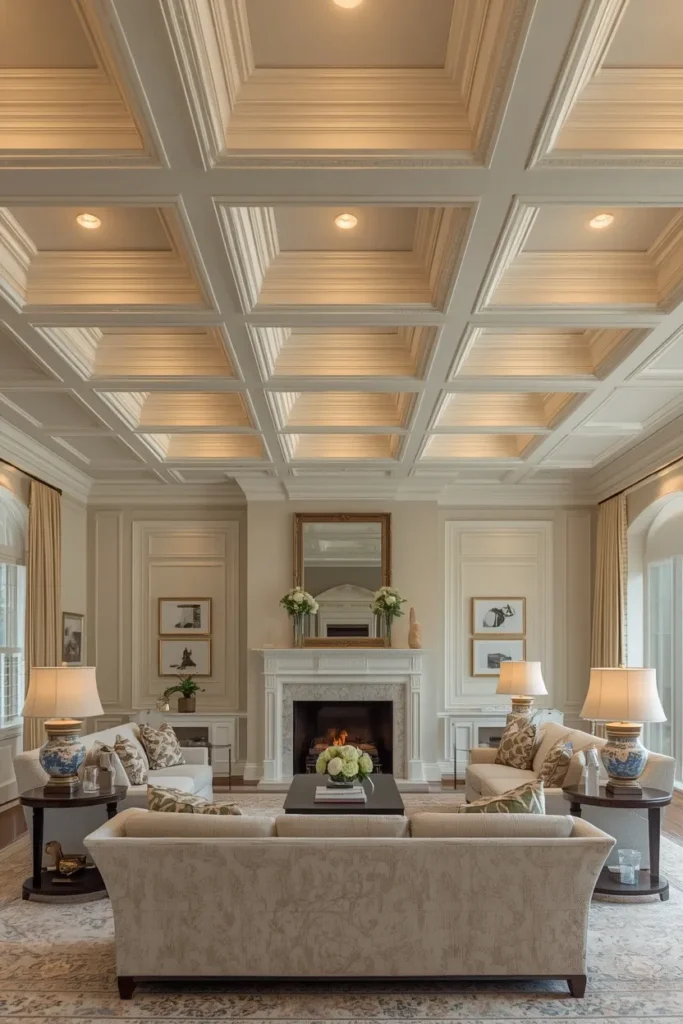
A grid of recessed panels — a coffered ceiling — creates a stunning architectural feature overhead. Inside each coffer, or along the grid lines, recessed downlights are tucked neatly, casting pools of warm light downward. The result is something you’d see in a historic estate or a high-end new build.
Design Breakdown
Coffered ceilings are one of the oldest and most revered architectural features in home design — they add depth, shadow, and instant prestige to any room. When you add integrated lighting, the effect becomes truly transformative.
This isn’t just about looks. The recessed placement within coffers allows you to angle light precisely where you want it, creating focal points on furniture groupings, artwork, or a fireplace.
Expert Tip
If a full coffered ceiling renovation isn’t in your budget, faux beam kits and MDF trim installed in a grid pattern can approximate the look for a fraction of the cost — often under $500 in materials.
Why It Works
The geometric pattern of coffers adds visual texture to the ceiling plane, making it an active part of the room’s design rather than dead space. The integrated lighting heightens this by creating dramatic interplay between light and shadow.
Best For
- Large, formal living rooms
- Traditional, transitional, and luxury style homes
- New builds with higher ceilings
Common Mistake to Avoid
Under-lighting the coffers. If you’re going to do this, lean into the drama. Space recessed lights no more than 4 feet apart within the grid to ensure full coverage.
Quick Wins
- Paint coffers a slightly lighter or darker shade than surrounding ceiling for subtle contrast
- Use adjustable-trim recessed cans to direct light toward key furniture pieces
- Pair with wall sconces for additional layering
- Finish the trim in a complementary color to your crown molding
7. Oversized Rattan or Woven Pendant
What You’re Seeing
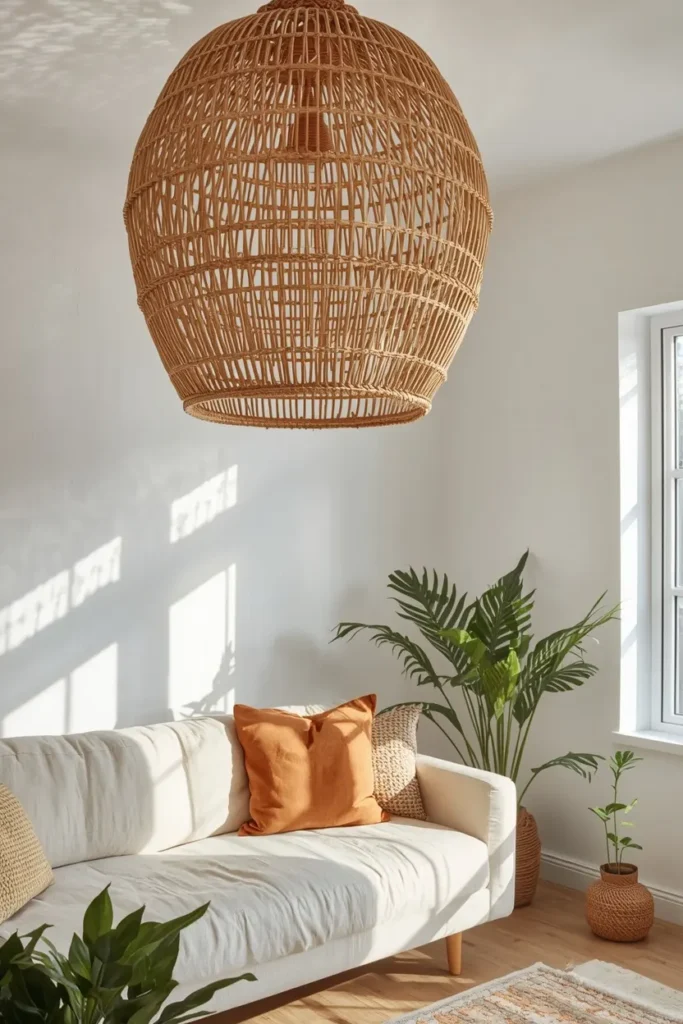
A massive natural fiber pendant — rattan, seagrass, or woven jute — hangs from the ceiling like a beautiful basket. It casts a gorgeous dappled pattern of light across the walls and ceiling. The room feels textured, organic, and effortlessly stylish.
Design Breakdown
Natural material pendants have exploded in popularity over the last few years, and they show no signs of slowing down. They work across a surprising range of interior styles — bohemian, coastal, Japandi, and even modern farmhouse.
The real magic is what they do with light. The woven material creates a complex pattern of shadows and light patches that dance across the room — no other fixture type creates this effect.
Expert Tip
Go large. The biggest mistake people make with woven pendants is buying one that’s too small. A pendant 24–36 inches in diameter feels dramatic in the right way. Anything smaller looks like it got lost on the ceiling.
Why It Works
Natural materials trigger a biophilic response — our brains instinctively find them calming and appealing. Combined with the warm, patterned light effect, a rattan pendant creates one of the most inviting atmospheres of any fixture type.
Best For
- Boho, coastal, Japandi, and eclectic styles
- Medium to large rooms
- Budget makeovers (great options under $100)
- Renters who want personality without permanent changes
Common Mistake to Avoid
Pairing with cold, bright bulbs. A rattan pendant with a daylight bulb looks strange. Always use warm Edison-style bulbs to complement the natural material.
Quick Wins
- Use a globe-style Edison bulb for maximum visual impact
- Pair with linen, cotton, and wood textures throughout the room
- Try a cluster of 2–3 smaller rattan pendants instead of one large one
- Hang at 6.5–7 feet from the floor for the best light spread
You May Also Like:
- Boho Living Room Ideas
- Cozy Living Room Ideas
- Earthy Cottage Living Room Ideas
- Scandinavian Living Room Ideas
- Quiet Luxury Living Room Ideas
8. Linear LED Suspension Above a Sectional
What You’re Seeing
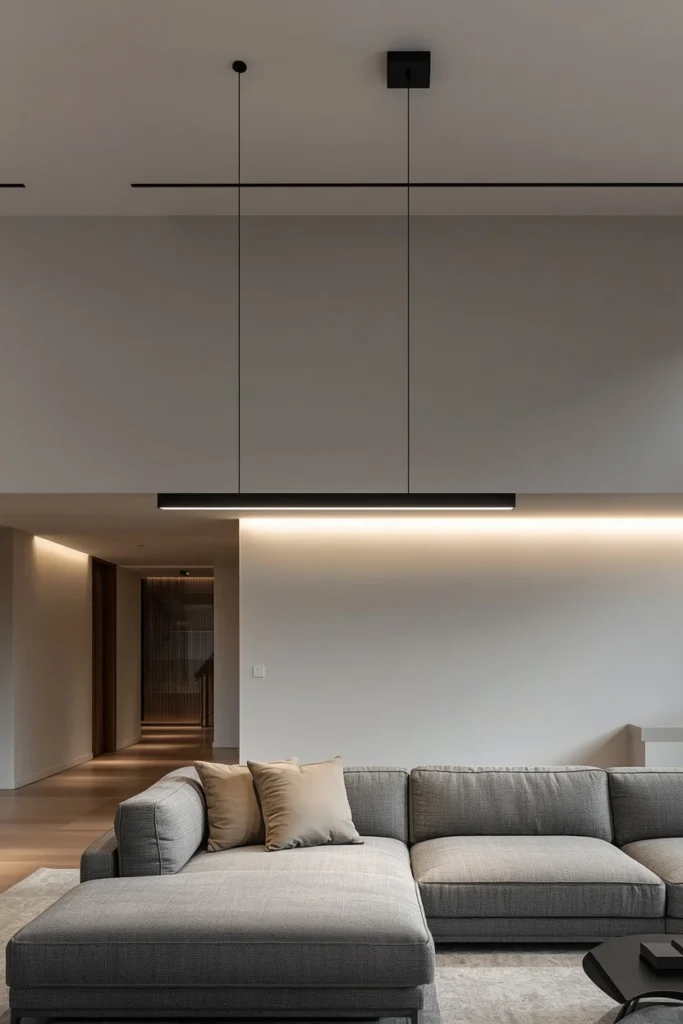
A long, sleek bar of light — matte black or brushed brass — suspends above a sectional sofa arrangement. It’s architecturally clean, modern, and unbelievably versatile. Think less “restaurant” and more “calm, elevated home.”
Design Breakdown
Linear LED pendants — long bar-style fixtures — were originally designed for kitchen islands and dining tables. But clever homeowners and designers have been adapting them to living rooms with stunning results.
Hung above a large sectional or sofa, a linear pendant helps define the seating area as its own distinct zone within an open floor plan. It creates visual weight overhead that anchors the furniture arrangement and makes the living room feel intentionally designed.
Expert Tip
The pendant length should be roughly 70–80% of your sofa’s length. For a 9-foot sofa, look for a fixture around 60–70 inches long.
Why It Works
In open floor plans, living rooms often lack ceiling differentiation — everything looks like one big room. A linear pendant placed specifically over the seating area creates an invisible boundary that defines the space. It’s the ceiling equivalent of an area rug.
Best For
- Open floor plans
- Large rooms with defined seating areas
- Modern, minimalist, and Japandi styles
- New builds and renovated spaces
Common Mistake to Avoid
Hanging it too high. For a living room application (not task-oriented like a kitchen), you want the fixture around 60–66 inches from the floor — low enough to feel intimate without obstructing sightlines.
Quick Wins
- Choose a finish that matches your hardware (door handles, cabinet pulls)
- Pair with a warm color temperature for a relaxed feel
- Use on a dimmer for mood flexibility
- Consider a double-bar version for extra drama in very large rooms
Here’s where it gets interesting: Most people think of ceiling lighting as purely functional. But the next two ideas treat it as pure design — and the rooms they create are unforgettable.
One thing designers always say: Don’t underestimate the power of scale. The most common lighting mistake isn’t the wrong style — it’s the wrong size. When you’re unsure, go one size bigger. Almost every living room can handle more ceiling presence than the homeowner initially thinks. A fixture that feels “too big” in the store will almost always feel exactly right once it’s hanging in your room.
9. Backlit Coffered or Tray Ceiling Panels
What You’re Seeing
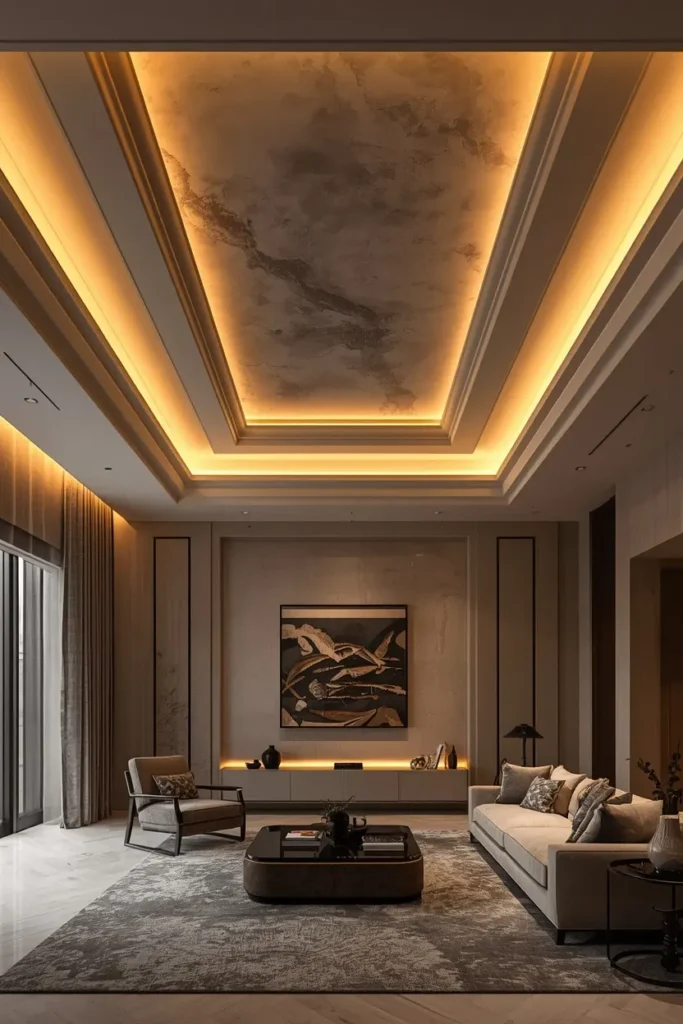
A tray ceiling with an inner ledge glowing from behind — the ceiling itself seems to pulse with soft, recessed light. The architectural depth of the tray is doubled by the light washing upward from within it. It looks expensive. It feels otherworldly. And it’s more achievable than you’d think.
Design Breakdown
This builds on the cove lighting concept from Idea #2 but takes it further. A tray ceiling — one with a recessed center panel — gives you a natural ledge to run LED strips inside, pointing upward or inward. The result is a ceiling that becomes a dramatic light sculpture.
For homes without a tray ceiling, this can be approximated using a large suspended frame or canopy structure, which some homeowners install as a DIY project or buy as a modular system.
This simple change can completely transform the room — especially in spaces that feel flat or uninspired.
Expert Tip
For a truly elevated look, run two parallel LED strips in the tray at slightly different heights. This creates a softer, more dimensional glow rather than a single hard-lit ledge.
Why It Works
The light-within-architecture approach is deeply satisfying visually because it rewards looking upward. It rewards paying attention. The complexity of what the eye sees — architectural depth plus glowing light plus shadow — triggers genuine visual interest and the sense that a room has been thoughtfully designed.
Best For
- Luxury homes and high-end renovations
- Formal living rooms
- Large spaces with 9+ foot ceilings
Common Mistake to Avoid
Over-brightening it. Tray ceiling LED lighting works best at low to medium intensity. At full brightness it loses its magic and just becomes harsh overhead light.
Quick Wins
- Always run on a smart dimmer or smart home integration
- Use warm white (2700K) LEDs exclusively
- Add a center pendant inside the tray for layered drama
- Paint the interior of the tray a contrasting color to maximize depth
What’s your biggest living room lighting challenge right now? Is it a low ceiling, an awkward room shape, a rental situation? Tell me in the comments — I might be able to help.
10. Cluster of Mini Pendants at Varying Heights
What You’re Seeing
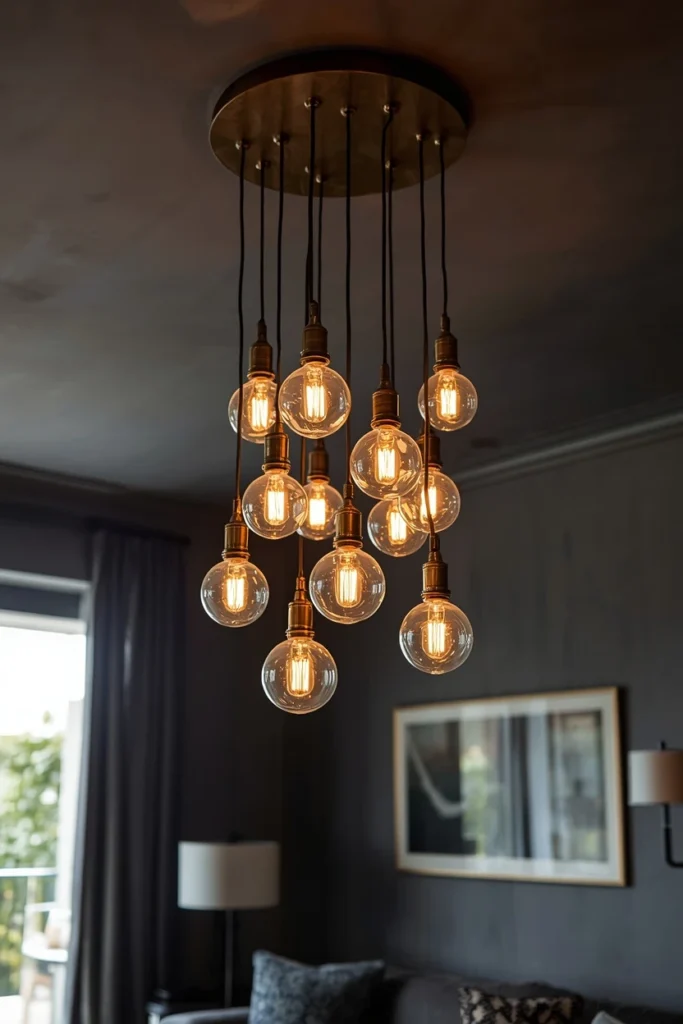
Visualize a ceiling that looks like a field of glowing bubbles — eight to twelve small pendant lights of varying sizes and drop lengths, clustering together over the main seating area. Some are clear globe bulbs. Some are smoked glass. Some are tiny brass cages. Together they feel like a constellation overhead.
Design Breakdown
Cluster pendant installations are one of the most dramatic living room lighting ceiling ideas you can execute — and they photograph beautifully for Instagram or Pinterest, which is probably how you found this post in the first place.
The key is variety within a consistent color palette. Mix globe sizes (3-inch, 5-inch, 8-inch) and hang them at different lengths — anywhere from 18 to 60 inches below the ceiling — to create organic movement. Keep all hardware in the same finish (brass, black, nickel) for cohesion.
Expert Tip
Use a multi-pendant canopy or a custom ceiling plate to keep all the cords organized and intentional. You can find these on Etsy and Amazon, or have an electrician create a custom solution with a ceiling medallion.
Why It Works
Multiple light points at different heights create incredible visual depth. The eye travels through the cluster — up, down, sideways — and the room gains a sense of richness that a single fixture simply cannot replicate. It’s the lighting equivalent of a gallery wall.
Best For
- Living rooms with 9+ foot ceilings
- Eclectic, bohemian, and transitional styles
- Design-forward homeowners
- Spaces that need a dramatic focal point
Common Mistake to Avoid
Going too matchy-matchy. Part of the charm of a pendant cluster is the collected, layered look. If every pendant is identical, the effect falls flat. Mix at least two or three different shapes or sizes.
Quick Wins
- Anchor with one or two larger pendants and layer in smaller ones
- Space the outer pendants slightly wider for a more natural cluster feel
- All bulbs should be the same color temperature (2700K)
- Photograph it during installation to find the most beautiful arrangement before hardwiring
Which of these 10 living room lighting ceiling ideas would you try first? I’m genuinely curious — let me know below!
Related Living Room Ideas You’ll Love
If these lighting ideas have you ready to rethink your whole living room, you’re going to want to explore these too:
- Living Room Chandelier Ideas
- High Ceiling Living Room Ideas
- Modern Dark Living Room Ideas
- Cozy Living Room Ideas
- Quiet Luxury Living Room Ideas
- 10 Modern Living Room Design Ideas
- 10 Luxury Living Room Ideas
- Scandinavian Living Room Ideas
Your Living Room Ceiling Is Waiting
Let’s be honest — most living rooms are doing the bare minimum with ceiling lighting. One basic fixture, no dimmer, wrong bulb temperature. Done.
But after reading through these 10 living room lighting ceiling ideas, you can see how much is possible with the right approach.
The ideas that tend to have the biggest impact? Layered lighting (Idea #1) transforms how a room functions across every time of day. Cove lighting (Idea #2) creates that hotel-suite softness that most people assume is only achievable with a renovation. And pendant clusters (Idea #10) give you a jaw-dropping focal point that becomes the first thing anyone notices when they walk in the room.
Here’s my challenge to you: pick just one of these ideas and commit to implementing it this week. Not all ten. Just one.
Maybe it’s ordering a new drum shade. Maybe it’s finally installing that dimmer switch. Maybe it’s mapping out a cove lighting strip for a weekend DIY. One change, done right, shifts the energy of the entire room.
Which of these ideas are you most excited to try — the bold statement piece approach or the softer, layered ambient method? Tell me in the comments.
And if you’re ready to go deeper on your living room, don’t miss our guide on how to decorate a living room step by step — it’s the full roadmap that makes every design decision click into place.
Up next? You might want to explore bedroom lighting ideas — because once you fix the living room, you’re going to want that same magic upstairs. Trust me on this one.